Google Ads Training for Beginners: What You Need to Learn Before Running Your First Campaign
Google Ads can put a business in front of potential customers when they are actively searching for a product or service.
That sounds straightforward.
In practice, learning Google Ads involves much more than opening an account, choosing a few keywords, writing advertisements and setting a budget.
For someone completely new to Google Ads, a better starting question is:
What do I need to understand before I start spending money?
Good Google Ads training should teach you how the different parts of a campaign fit together, how to interpret the information generated by your campaigns, and how to make decisions based on business objectives.
This guide explains what a beginner should learn before managing a Google Ads campaign.
What Is Google Ads?
Google Ads is Google’s advertising platform. Businesses can use it to promote products and services across Google’s advertising ecosystem.
For anyone learning paid search, Search campaigns provide a useful introduction to an important principle:
A person searches for something, and relevant advertisements may become eligible to appear for that search.
The advertising auction involves several factors, including targeting, relevance, bidding and ad quality. Paying for an advertisement does not by itself guarantee a particular position.
That means learning Google Ads involves understanding how targeting, keywords, advertisements, landing pages, conversions and measurement work together.
If you want guided instruction while learning these fundamentals, you can review our Live Online Google Ads Training programme and see how the learning approach fits your goals.
Start With the Business Goal
Before learning campaign settings, learn to identify the business objective.
A business might want:
- enquiries;
- phone calls;
- online purchases;
- appointment bookings;
- quotation requests;
- registrations;
- visits to a physical location;
- qualified leads.
These outcomes require different considerations.
A campaign intended to generate website traffic may be structured differently from one intended to generate qualified enquiries.
For that reason, good Google Ads training should begin with the business objective rather than with the advertising platform’s settings.
Understand the Basic Campaign Structure
A beginner needs to understand how the main parts of a Google Ads account relate to one another.
Depending on the campaign type and the current Google Ads interface, available settings can vary. The basic organisational concepts, however, remain important.
You should understand the relationship between:
Account → Campaign → Ad group → Keywords/targeting → Ads → Landing page
You should also understand that different campaigns can have different:
- objectives;
- budgets;
- targeting;
- bidding approaches;
- audiences;
- locations;
- advertisements;
- conversion goals.
This makes it easier to plan an account logically rather than treating every advertising activity as one large campaign.
Learn How Customers Search
One of the most useful skills in paid search is understanding the difference between:
what a business sells
and
what a potential customer actually searches for.
Imagine a company that provides emergency plumbing services.
The business might describe itself as an:
Emergency Plumbing Company
Customers, however, could search for:
- emergency plumber near me;
- plumber for leaking pipe;
- plumber open now;
- burst pipe repair;
- plumbing repair service.
Those searches provide clues about what people need and how they describe that need.
A Google Ads learner should become comfortable translating a business’s products or services into the language customers use when searching.
That is the foundation of effective paid-search keyword research.
Learn Paid-Search Keyword Research
Keyword research for Google Ads involves considerably more than finding terms with high search volume.
You need to consider:
- relevance;
- search intent;
- commercial value;
- competition;
- likely customer needs;
- location;
- the products or services actually offered;
- the landing page available for the search.
A popular keyword can still be a poor choice for a particular business.
A more useful question is:
Would a person searching for this be a suitable potential customer for this business?
Google’s guidance recommends building keyword ideas around the terms customers use to describe the products or services they are looking for.
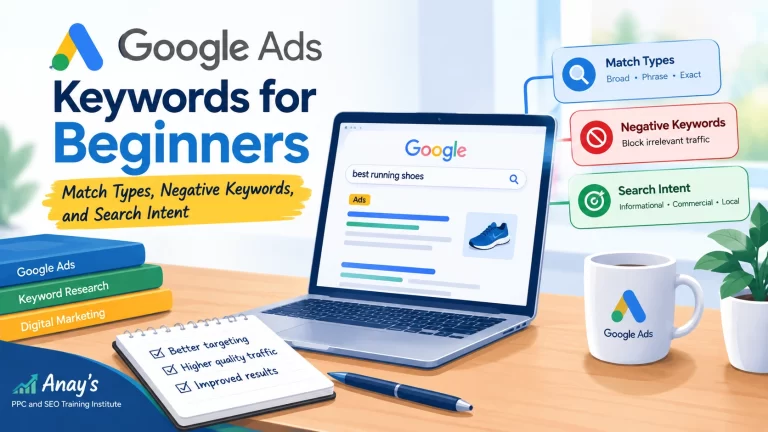
Understand Keyword Match Types
Google Ads currently provides three keyword match types:
- broad match
- phrase match
- exact match.
They influence how closely a keyword relates to a user’s search before an advertisement becomes eligible for the auction.
Match types are best understood as part of a broader targeting strategy. They should be considered alongside search intent, campaign structure, negative keywords and the actual searches being generated.
Google’s matching system has also evolved over time. Current Google documentation explains that matching can consider the meaning and context of a search rather than relying only on identical wording.
For a detailed explanation of the three match types and practical examples, see our article Google Ads Keywords: Match Types, Negative Keywords and Search Intent.
Understand Negative Keywords
Effective targeting also requires deciding which searches are unsuitable for your advertisements.
Negative keywords can help exclude searches that are irrelevant to the products or services being advertised.
For example, a business selling paid professional training may discover searches containing terms such as “free” that are not relevant to its particular offer.
However, exclusions need to be handled carefully.
An overly restrictive negative-keyword strategy can remove searches that might otherwise have been valuable.
Google’s Search Terms report can help advertisers examine the searches associated with their ads and identify potentially useful or irrelevant traffic.
The Google Ads Keywords article above covers negative keywords and search-term analysis in greater depth.
Learn to Write Relevant Ads
A Google Ads beginner should learn how to connect:
search → advertisement → landing page
If someone searches for a particular service, the advertisement should make it reasonably clear that the business offers that service.
Good ad writing considers:
- the customer’s need;
- the search intent;
- the actual business offer;
- important differentiators;
- the desired action;
- the landing-page experience.
Accuracy matters too. An advertisement should not promise something that the business or its landing page cannot deliver.
Understand Ad Assets
Google Ads campaigns can use various assets to provide additional information and give users more ways to interact with an advertisement.
Training should cover the purpose of relevant assets and how they support the main advertisement.
A beginner should understand:
- why assets are used;
- what information belongs in them;
- how they complement the advertisement;
- why accuracy and relevance matter.
The available assets and interface can change, so good training should teach the underlying principles alongside the current platform workflow.
Learn About Landing Pages
The advertisement is only one part of the customer’s journey.
After clicking, the visitor reaches a landing page. That page needs to support the expectation created by the advertisement.
A useful landing page should make it reasonably clear:
- what is being offered;
- who it is for;
- why the visitor should consider it;
- what the next step is;
- how to take that step.
For example, an advertisement for a particular service may work better when it leads to a relevant service page rather than a generic homepage.
Landing-page evaluation therefore deserves a place in beginner Google Ads training.
Understand Location Targeting
Many businesses serve customers within particular geographic areas.
A business might target:
- a city;
- several nearby cities;
- a region;
- selected areas within a larger geographic area.
Location targeting should reflect where the business can actually serve customers.
A useful planning question is:
Where can this business realistically serve customers profitably?
That answer can help determine how geographic targeting should be approached.
Learn Budgets and Bidding
Google Ads involves real advertising expenditure, so beginners need a basic understanding of:
- campaign budgets;
- bidding;
- bid strategies;
- clicks;
- impressions;
- conversions;
- cost;
- cost per conversion.
You do not need to memorise every bidding option at the beginning.
You do need to understand the relationship between the money being spent and the outcome the campaign is intended to produce.
That provides a much better foundation for campaign management than focusing on individual settings in isolation.
Learn Conversion Tracking
Conversion tracking is one of the most important areas for anyone learning Google Ads professionally.
Imagine a campaign receives 500 clicks.
That number alone cannot tell you whether the campaign succeeded.
What happened after those clicks?
Did visitors:
- submit an enquiry?
- purchase something?
- book an appointment?
- call the business?
- register?
- complete another valuable action?
Conversion tracking helps connect advertising activity with meaningful business outcomes.
A beginner should therefore learn to distinguish between:
traffic metrics
and
business-result metrics.
Before making optimisation decisions, you need to know what the campaign is actually measuring.
Learn to Read Search Terms and Campaign Data
Once a campaign begins generating data, the work becomes more analytical.
You are now looking at evidence and deciding what that evidence means.
The Search Terms report can reveal the searches associated with advertisements and help identify both useful opportunities and irrelevant traffic.
A learner should gradually become comfortable asking:
- Which searches are producing useful traffic?
- Which searches are irrelevant?
- Which advertisements are performing better?
- Are conversions actually happening?
- Is the landing page appropriate?
- Is the campaign reaching the intended location?
- Is the cost reasonable for the business?
- What should be tested next?
These questions begin to move you from campaign setup toward campaign management.
Learn Optimisation
Creating a campaign and managing a campaign are different skills.
Optimisation involves examining available evidence and deciding whether something should change.
Depending on the campaign, this may involve reviewing:
- search terms;
- keywords;
- negative keywords;
- advertisements;
- assets;
- landing pages;
- locations;
- budgets;
- bidding;
- conversion data.
A useful optimisation decision has a reason behind it.
For example:
What did I observe?
What does that information suggest?
What action would be appropriate?
How will I know whether the change helped?
That way of thinking is more valuable than making frequent changes simply to keep a campaign busy.
Understand the Difference Between SEO and Google Ads
SEO and Google Ads can both help businesses gain visibility in search, but they are different disciplines.
SEO focuses on improving a website’s organic visibility.
Google Ads involves paid advertising.
There are areas where the two disciplines overlap. Keyword research and search intent, for example, can be relevant to both.
The way those concepts are applied, however, can differ.
Anyone learning both SEO and Google Ads should understand those similarities without assuming that the two disciplines work in exactly the same way.
Learn the Common Beginner Mistakes
A good training programme should also prepare you for mistakes that inexperienced advertisers commonly make.
These can include:
- choosing keywords without understanding intent;
- focusing heavily on clicks while ignoring conversions;
- sending every advertisement to the homepage;
- targeting areas the business does not serve;
- adding excessive negative keywords;
- changing campaigns without enough evidence;
- ignoring search-term data;
- writing generic advertisements;
- failing to establish conversion tracking;
- judging performance too quickly;
- treating every campaign as though it were identical.
Understanding why these mistakes cause problems can help a learner develop better campaign judgement.
Do You Need to Learn Every Google Ads Feature Immediately?
No.
A beginner does not need to master the entire Google Ads ecosystem before understanding the fundamentals.
A sensible progression is:
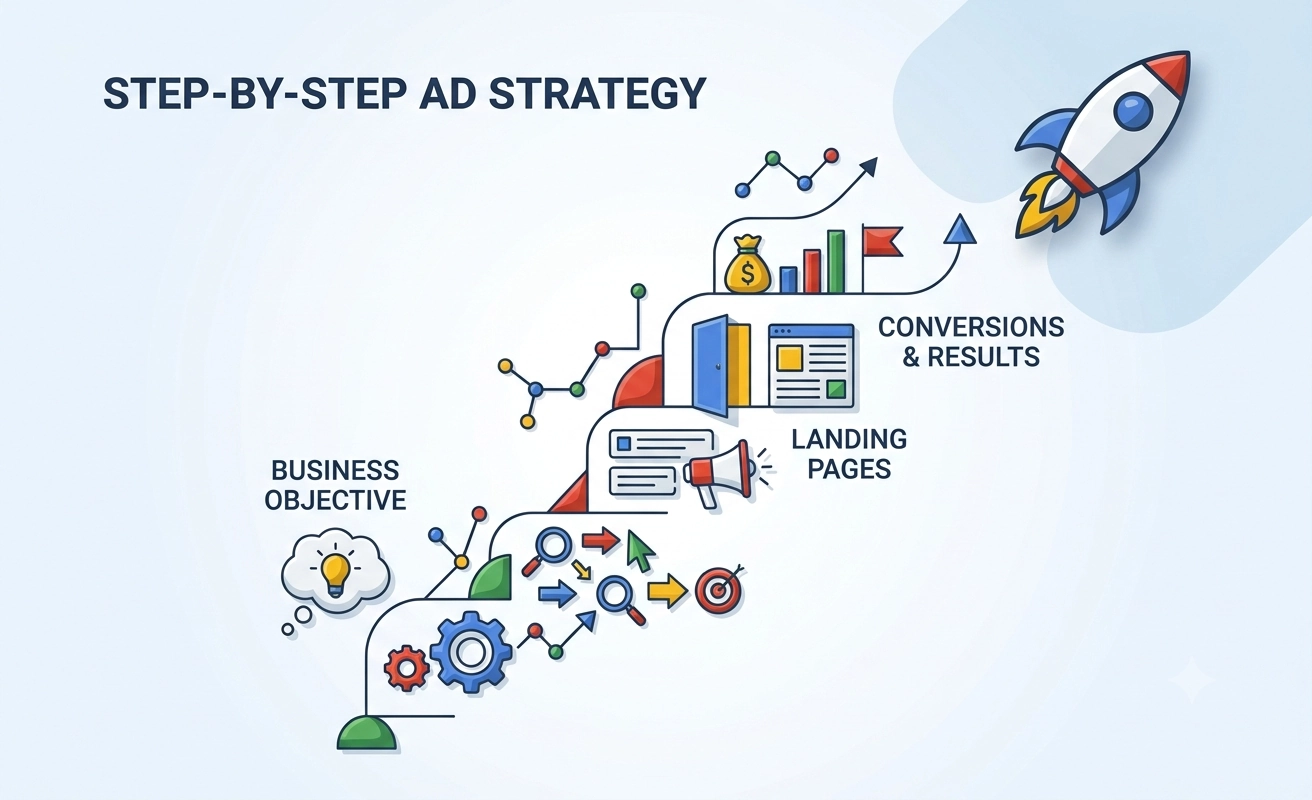
Business objectives → Search fundamentals → Keywords → Targeting → Ads → Landing pages → Measurement → Analysis → Optimisation
Once those foundations are understood, additional campaign types and advanced features become easier to approach.
Practise With a Google Ads Campaign Scenario
Reading about Google Ads is useful.
Practising decisions is where the knowledge starts becoming practical.
A beginner exercise could use a fictional or real business and provide:
- its products or services;
- its target location;
- its ideal customers;
- its website;
- its business goal.
The learner could then develop:
- campaign objectives;
- keyword ideas;
- initial targeting;
- sample advertisements;
- negative keyword ideas;
- landing-page recommendations;
- conversion goals;
- an optimisation plan.
The exercise does not require actual advertising expenditure.
Its purpose is to develop the reasoning needed to plan and evaluate a campaign.
If you want to build that reasoning through guided practice, you can register for live online training and explore whether the programme matches your learning needs.
What Should You Be Able to Do After Good Beginner Training?
By the end of a solid beginner-level programme, you should be able to explain:
- what Google Ads is;
- how a Search campaign works at a basic level;
- how campaign structure works;
- how to conduct basic paid-search keyword research;
- what match types are used for;
- what negative keywords do;
- how search intent affects targeting;
- how to write relevant advertisements;
- why landing pages matter;
- how location targeting affects a campaign;
- what budgets and bidding are intended to accomplish;
- why conversion tracking matters;
- how to read basic campaign data;
- how search-term information can inform optimisation;
- how to explain the reasoning behind a campaign decision.
You should also know where your current knowledge ends.
That matters because advertising involves real budgets and real business consequences. A responsible beginner should know when further research, supervision or specialist assistance is appropriate.
How Long Does It Take to Learn Google Ads?
There is no fixed number of days or weeks after which someone automatically becomes proficient.
The basic concepts can be learned relatively quickly.
Good judgement takes longer.
For example, knowing what a match type means is one level of knowledge.
Knowing how keyword targeting should be approached for a particular business is a more advanced practical skill.
Being able to diagnose poor performance from campaign data requires still more experience.
Those abilities develop through practice and repeated exposure to different campaign situations.
What Should You Look for in Google Ads Training?
When comparing training programmes, look beyond the number of lessons or hours.
Ask:
What will I actually be able to do when the training is finished?
Useful beginner training should include:
- concepts;
- current platform practices;
- practical examples;
- exercises;
- campaign planning;
- keyword research;
- ad writing;
- conversion measurement;
- data interpretation;
- optimisation thinking.
Training should explain the reasoning behind campaign decisions as well as the mechanics of using the platform.
If you are comparing programmes and want to ask about the learning format, practical exercises, or suitability for your current level, you can Contact Us or Call.
Frequently Asked Questions
How long does it take to learn Google Ads as a beginner?
Can I learn Google Ads without running a real campaign?
What should I learn before creating my first Google Ads campaign?
Building a Strong Foundation Before Your First Google Ads Campaign
A beginner learns Google Ads more effectively by understanding the reasoning behind each stage of campaign management.
Start with the business and its customers. Learn how their needs translate into searches, how those searches can be targeted, and how the resulting traffic should be measured. With that foundation in place, campaign analysis and optimisation become much easier to understand.
The aim of training is to develop enough knowledge and practical judgement to make informed advertising decisions — particularly when those decisions involve a real business and a real budget.
If you are looking for Google Ads training, choose a programme that develops that understanding through explanation and practice rather than one that focuses only on getting a campaign live.