

Live Online Google Ads Training: What Learners Should Expect
In brief: Live online Google Ads training should teach learners how campaign decisions connect to business goals, search intent, budgets, ads, landing pages and conversion measurement. It is Google Ads-specific training—not a promise of expertise across every PPC platform.
What useful Google Ads training should cover
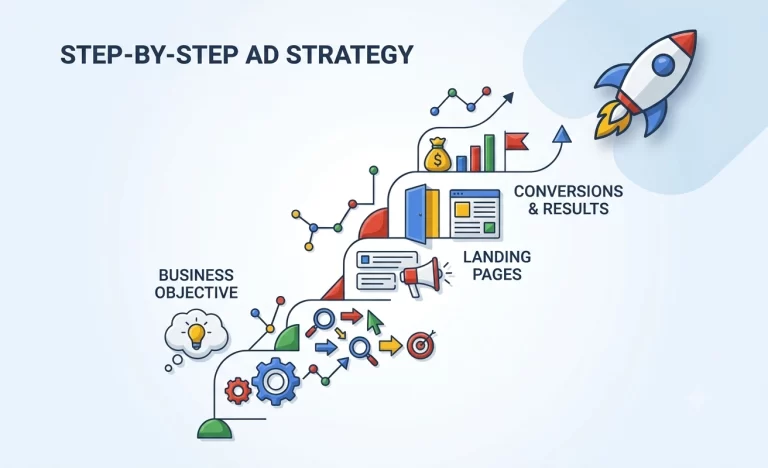
Learning where to click is not enough. Interfaces and automated features change. A learner needs to understand why a campaign is structured in a particular way, what success means for the business and how to recognise waste or misleading conclusions.
A practical foundation can include:
- business goals and campaign objectives;
- account and campaign structure;
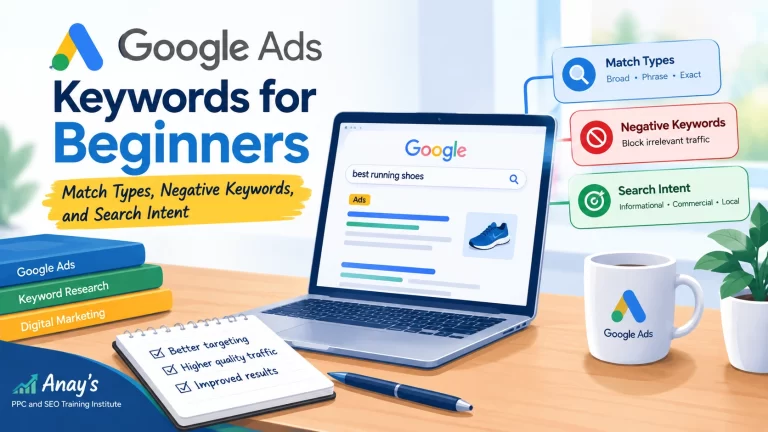
- search intent, keywords and match behaviour;
- negative keywords and irrelevant traffic control;
- clear ad messaging and policy awareness;
- landing-page relevance;
- budgets, bids and responsible use of automation;
- conversion measurement and reporting; and
- ongoing review and optimisation.
Why conversion measurement matters
Clicks alone do not show whether advertising helped the business. A conversion is a meaningful action such as an enquiry, call, sign-up or purchase. Google explains that conversion tracking can connect ad interactions to those actions and help identify which ads and keywords contribute to results.
Training should also discuss limitations. Tracking must be configured correctly, privacy obligations still apply, and small data sets should not be treated as certainty. A high click-through rate does not automatically mean profitable advertising.
Live guided practice
The approved training is delivered live online for learners in India through Zoom or Google Meet. Communication can use English, Hindi or Punjabi according to the learner’s comfort, while platform terminology normally remains in English.
Learners need their own computer for hands-on work. Without one, the class becomes mainly theoretical. Screen recording is not permitted, although learners should take their own written or typed notes.
One-to-one and small-group learning
Training may be one-to-one or in a small group. The curriculum adapts to the learner’s starting level and objectives. Advice may be given about the most suitable level, but the trainee makes the final choice.
No free full demonstration class is offered. A no-obligation pre-enrolment discussion is available to clarify the learner’s needs, delivery format and current terms before enrolment.
Realistic expectations
Training can build understanding and guided practice, but it cannot guarantee advertising results, employment or income. Google Ads changes over time, so the durable skill is learning how to evaluate decisions rather than memorising one version of the interface.
The detailed syllabus may evolve with the platform and learner level. For the current offering, policies and enrolment pathway, visit Live Online Google Ads Training or request a pre-enrolment discussion.
Frequently asked questions
Is this a general PPC course?
No. The training focuses on Google Ads. It does not claim to teach every paid-advertising platform.
Do I need my own computer?
Yes, a computer is needed for hands-on practice. A phone alone is not a practical substitute for working inside the advertising platform.
Can sessions be recorded?
No screen recording is permitted. Learners should take their own handwritten or typed notes.
Is a free demo class available?
No free full demo class is offered. A no-obligation discussion is available before enrolment.
Does completing training guarantee campaign results?
No. Results depend on the offer, market, website, tracking, budget, competition, decisions and continued execution.

I thoroughly enjoyed reading this article—it was concise
and well-researched! The site looks professional and inviting.
Thank you, Phoebee!
Awesome
Very good
Awesome
Good
Awesome
Awesome
With havin so much content do you ever run into any problems of plagorism or copyright violation? My website has a lot of exclusive content I’ve either created myself
or outsourced but it looks like a lot of it is popping it up all
over the internet without my authorization. Do you know any ways to help protect against content from being stolen? I’d really
appreciate it.
Hi,
That’s a really common worry, and honestly, you’re not alone. Once something is published online, it’s almost impossible to stop people from copying it completely. That said, it doesn’t usually cause as much damage as it feels like it might.
The key thing is making sure search engines know you published it first. If Google sees your site as the original source, copied versions usually don’t get much traction. It’s also a good idea to keep an eye on things now and then—simple tools or even a quick Google search can help you spot copied content early.
If you do find someone using your content without permission, you can file a DMCA (Digital Millennium Copyright Act) takedown, which often gets results fairly quickly. A few basic precautions can also discourage casual copying. This is a appeal that one needs to file with theb platform on which your content has been published afterwards.
So while you can’t completely prevent it, you can definitely stay in control—and in most cases, your original content will still win out. Ys, for this, you will need to keep a proveable record that content originally belonged to you and maybe appeatred on your site first, if it did.
I hope this helps.