
What Professional On-Page SEO Services Actually Involve
Choosing on-page SEO services can be difficult when one provider offers little more than keyword and title-tag changes, while another proposes a much broader engagement. Understanding what the work should cover—and what it should not automatically include—helps you assess the value and scope before hiring.
Professional on-page SEO improves important website pages by aligning their content and structure with business goals and search intent. Work may include metadata, headings, internal links and relevant technical checks, depending on the agreed scope.
In brief: Professional on-page SEO services start by understanding your business and the job each important page has to do. From there, the work improves titles, headings, content structure, internal links and relevant technical signals in priority order. Depending on what is agreed, it can include analysis, recommendations, implementation and review, and none of it can promise rankings or traffic.
Picture a services website with a page for commercial roofing. Its title tag talks about roofing in general, its main heading says “Our Solutions,” its copy could describe any contractor, and no other page on the site links to it. (This is a hypothetical example, not a client story.)
Now imagine two providers reviewing it. One proposes a keyword pass over the title tags. The other asks what the page is supposed to achieve, who should find it, and why nothing points to it. Both are offering on-page SEO, but you are buying very different work. This guide explains what the second approach looks like, so you can judge what you’re actually engaging someone to do.
It starts with your business, not the page
Before I change anything, I want to know what the business offers, who its customers are, and what each important page is meant to do for them. Then I look at whether the existing pages match what people searching for those services actually want. Where it’s available, I add first-party evidence, such as Google Search Console data.
I document what I learn, review the website against it, and share my findings and a proposed plan before any work begins. Work starts once that plan has been discussed and approved. If you’re still deciding who to hire, I’ve covered what to agree up front in what to settle before hiring on-page SEO help.
Each page gets one clear job
A page that tries to answer several different searches usually answers none of them well. So the first question for each important page is: what is this page for, and does its content serve that purpose?
This is also where overlap shows up. If two pages on a site both aim at the same search, they tend to dilute each other. In the roofing example, a second page about “roof services” might be competing with the commercial page. Deciding which page owns which topic comes before any rewriting.
Titles, headings and structure: the part people see first
Titles and meta descriptions are often treated as the whole job. On-page SEO is not simply inserting keywords into tags; it’s deciding what each element should communicate to a searcher who has seconds to choose a result.
Headings build a hierarchy a reader can scan, and the content beneath them should be complete and organized enough to answer the question that brought the visitor there. Each change has a reason: what the element currently says, what it should say, and what the change is meant to improve.
Internal links show how your pages relate
Internal links tell visitors and search engines which pages matter and how they connect. In practice, that means checking whether your important pages are supported by relevant links from related pages, whether the anchor text describes the destination, and whether the navigation reflects how the site is meant to work.
Back to the roofing page: it receives no links from the homepage, the related service pages or any supporting content. Adding a few well-placed, relevant links would likely help it far more than rewording its title, though neither change guarantees any particular result.
Technical foundations, only where they affect the work
Some technical matters sit close to on-page work: whether pages can be indexed, how canonical signals are set, how URLs are structured, how images are handled, and page experience issues that affect a particular page. I look at these where they bear on the pages being improved, not as a general technical overhaul.
Some of those fixes are straightforward. Others need a developer, and larger development work is scoped separately. When it’s unclear whether a problem sits on the page or somewhere deeper, a website audit is a better first step than guessing.
Prioritizing, then moving to implementation
A review will usually find more than anyone can fix at once. Priorities follow the importance of the page to your business, what the evidence shows, and the effort involved. A change to a page that matters, backed by evidence, comes before a tidy-up on a page that nobody visits.
It also helps to separate three things:
- Recommendations: what should change, why, and in what order.
- Implementation: making the agreed changes, which depends on the agreement and on access to your website platform.
- Dependencies: anything that needs your approval, your content resources or a developer.
Whether I make the changes or give you a plan for your team is decided in the scope, not assumed. My On-Page SEO Services page explains how I scope this work.
How progress is measured
Before changes go live, I record a baseline. After that, I review relevant Search Console data, including impressions, clicks, queries and page-level performance, over a period that suits the site and the work done. Rankings are one signal among several. Where measurement is available, I also look at relevance, engagement and enquiries.
Search results depend on competition, search changes and many factors outside any one page, so the review reports what the evidence shows rather than what anyone hoped for.
What you should expect from an on-page SEO consultant
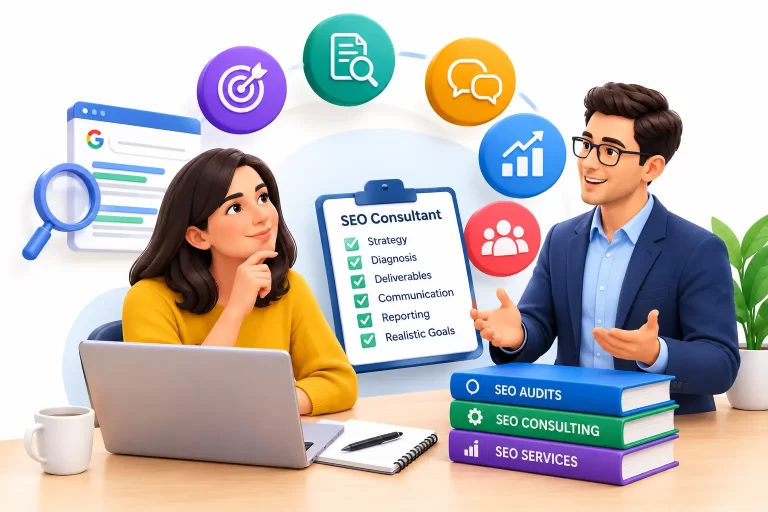
You should expect to be asked about your business before changes are proposed, and to receive a reason for each recommendation. The scope should state what is included, what depends on your access or approval, and what would need separate work. You should also get a record of what changed. Not every business needs an outside provider for this: if you have a capable in-house team, a prioritized set of recommendations may be all you need, and a first conversation may simply help you decide which pages deserve the effort.
I work on projects directly, so you deal with the person doing the analysis. I’ve worked in website, digital-support and project-coordination roles since 2014 and have worked dedicatedly in SEO since 2020, including on English-language websites serving businesses in the United States. My SEO portfolio shows websites I’ve worked on, with my role explained.
FAQs
What do on-page SEO services include?
It depends on the website, but commonly a page-level review, metadata and heading improvements, guidance on content structure, internal-link recommendations and relevant technical checks. Copywriting, substantial development, link building and ongoing monitoring are not assumed and are agreed separately.
How is professional on-page SEO different from making basic changes myself?
Basic edits, such as rewriting a title, are within reach of most site owners. The difference is knowing which pages to change, what the data shows, and what to leave alone. For example, changing a URL or merging pages without redirects can lose visibility the page already has.
Does on-page SEO include technical SEO and content optimization?
Relevant technical foundations may be part of the work, but extensive development is scoped separately. Optimizing existing copy is different from writing new content, and writing is not automatically included.
How long does it take to see the effects of on-page improvements?
There is no timeline I can honestly promise, because it depends on how much is implemented, how often search engines revisit the pages, the site’s size and the competition. I agree review points in advance and compare results against the baseline.
Do I need an SEO audit before hiring an on-page SEO consultant?
Not always. If you already know which pages matter and why, a scoped on-page engagement may be enough. If traffic has dropped without explanation, or different providers have given you conflicting views, an audit first is usually the safer route.
Where to start
Tell me which website or group of pages matters most and what you want it to achieve, and I’ll help you work out a proportionate scope. If the picture is unclear, you can ask me to quote a website audit instead. To get started, contact me with your URL and a few lines about your concerns. WhatsApp is my preferred way to begin, and email or the contact form work too. If you want to see the wider range of work I do, the SEO services overview is a good place to look.
You can start by sending me a WhatsApp message, emailing me, or using the contact form. If you prefer to speak first, you can also call me.