How to Improve On-Page SEO for a Service Website
Most service businesses have a handful of pages — home, a few service pages, maybe a locations or about page — and each one is doing a lot of work. Getting on-page SEO for a service website right is less about tricks and more about making sure each page clearly matches what someone searching for that service actually wants. Here’s what to check.
Start with search intent, not keywords
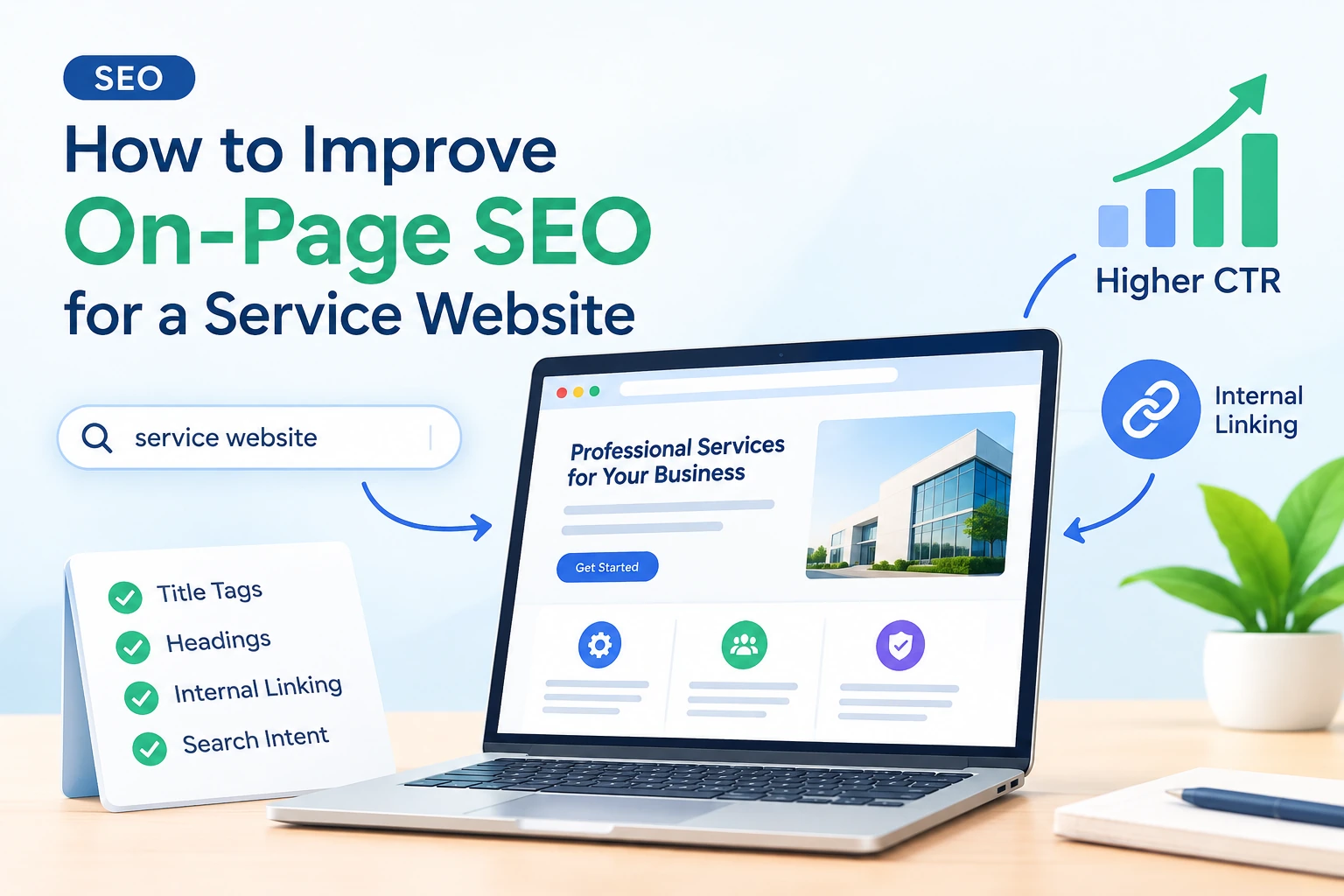
Before touching a title tag, it’s worth asking: what is someone actually trying to do when they search the phrase this page targets? Are they comparing providers, trying to solve a problem themselves, or ready to book? A page that answers the wrong version of that question won’t perform well no matter how well the title tag is written. This is why the audit and on-page steps are different exercises — an audit finds the mismatch, on-page work fixes it.
If you’re not sure whether a page has an intent, relevance, structure, or technical problem, an SEO audit can help identify what deserves attention before further on-page changes are made.
Title tags and meta descriptions
The title tag is the clickable headline in search results and browser tabs, and it’s one of the clearest signals you can send about what a page covers. Google’s own guidance suggests writing a title that plainly states the page’s topic and keeping it to roughly 60 characters so it isn’t cut off in results. For a service page, that usually means naming the service and, where relevant, who it’s for — clear beats clever here.
The meta description doesn’t directly influence rankings the way a title tag can, but it does shape whether someone clicks. Google generates the visible snippet from page content and sometimes from the meta description itself, so a short, accurate summary of what the page offers — around 150 characters — is worth writing deliberately rather than leaving to chance.
Headings that reflect real structure
Headings (H1 down through H3) should describe how the page’s content is actually organized, in order, without skipping levels just to make text bigger or smaller. One clear H1 stating the page’s topic, then H2s for the main sections a reader (or Google) would expect — what the service includes, how it works, who it’s for — with H3s only where a section genuinely has sub-points.
Internal links that connect the site
Internal links do two jobs: they help visitors find related pages, and they help Google understand which pages on your site matter and how they relate. For a service business, that usually means linking from relevant blog content to the service page it supports, and linking between related services rather than leaving every page as an island reachable only from the main menu.
Content that matches the page’s job
Each service page should say plainly what the service is, who it’s for, and what’s involved — in your own words, addressing the real questions a prospective client would have. Thin, generic descriptions (“we offer excellent SEO services”) don’t give Google or a visitor much to work with. Specific, concrete language about what actually happens does.
If you’re learning how these decisions fit together rather than hiring someone to make them for you, live online SEO training can provide a practical way to build that understanding through guided learning and exercises.
What on-page SEO can’t do on its own
On-page work makes a page easier to understand and use — it doesn’t control whether other sites reference yours, what your competitors are doing, or how a given search query happens to be evaluated on a given day. It’s a foundation, not a finish line, and it’s worth doing well regardless of how quickly (or slowly) it shows up in rankings, because it also makes the page genuinely better for the humans reading it.
When to bring in outside help
If you’ve addressed the basics above and a page still isn’t performing the way you’d expect, or if you’re not sure whether the underlying issue is on-page, technical, or something else entirely, that’s a reasonable point to get a second opinion rather than guessing further.
If you’d like help applying this to your actual pages, our On-Page SEO service works through titles, structure, internal linking and content for the pages that matter most to your business.