
Local SEO Services: What Can Be Improved on Your Website and Google Business Profile?
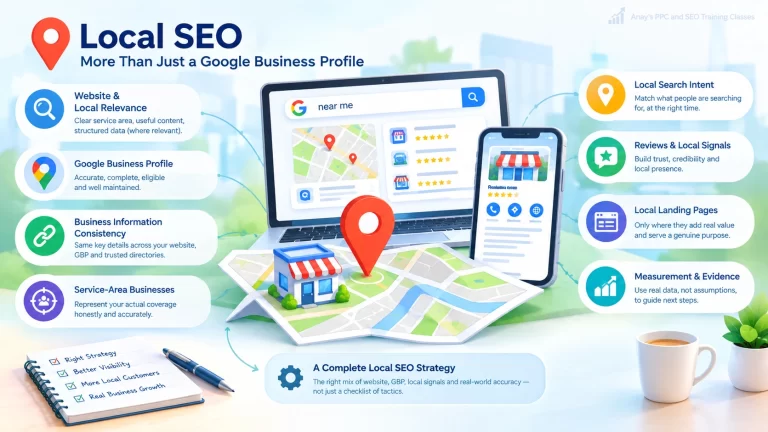
Professional local SEO services go beyond optimizing a business profile. They bring together your website, business information and genuine service areas to help local customers find and understand your business. Learn what a professional engagement can include, how priorities are set, and how progress can be assessed using available data.
Local SEO services help businesses improve how they appear in local search by bringing their website, business profile and business information into alignment. A professional engagement may include reviewing service areas, checking information consistency, improving local relevance and measuring progress. The work should reflect how the business actually serves customers, with priorities and responsibilities agreed in advance.
Local SEO Services: What a Professional Engagement Covers
In brief: Professional local SEO services look at how your website, your Google Business Profile and the way your business is described online work together to help nearby customers find you. The work starts with understanding your business, identifying priorities from the available evidence and agreeing what is included before anything begins. It cannot promise specific map positions, calls or leads, because Google decides what appears in search results.
Consider a home-services company that serves three suburbs from one small office. Its Google Business Profile lists a phone number it stopped using last year, its website describes every service on a single page, and the service areas on the profile don’t match the ones on the site. Someone searching may struggle to understand exactly what the company does or whether it serves their area. (This is a hypothetical example, not a client story.)
One provider might respond with a package of directory listings and a new page for every suburb. Another might start by asking how the business actually serves customers and which details are out of step. This guide explains what the second approach can involve, so you can make a more informed decision when considering local SEO support.
If you’d like to understand how I approach this work, you can read about my Local SEO Services.
What local SEO is trying to improve
The aim is to make it easier for people in or near the places you serve to find your business, understand what you offer, trust the information they see and get in touch.
That involves more than a single profile. It can include your website, Google Business Profile, the consistency of your business information and how clearly you explain the services you provide and the areas you genuinely serve.
Local SEO isn’t only for businesses with a shop or office that customers visit. Service-area businesses, such as contractors and mobile services, rely on local search too. The approach, however, may differ depending on how and where the business serves its customers.
Your website and your profile do different jobs
A Google Business Profile gives searchers a quick view of your business. It can show contact details, opening hours, photos, reviews and information about where you operate.
A website often gives customers the additional information they need to make a decision. It can explain your services in greater depth, demonstrate credibility and make it easier to enquire.
The two support each other. Your profile can help people discover your business and visit your website, while your website provides further context about what the profile represents.
Problems can arise when the information doesn’t match. For example, your website might show different opening hours, a phone number that appears in only one place, or services described in a way that doesn’t match your profile. I review them together because improving one while overlooking an inconsistency in the other can leave customers with unanswered questions.
In the suburbs example above, changing the profile alone would leave customers confused when they clicked through to the website.
Accurate, consistent business information
Your business name, address or service areas, phone number, opening hours and categories may appear in several places, including your website, Google Business Profile, directories and other websites.
When these details conflict, customers may be unsure which information to trust. Inconsistencies can also make it harder for search engines and other platforms to reconcile the information associated with your business.
Directory listings and citations can be useful when they are relevant and accurate. However, I don’t treat adding more listings as an automatic solution. The aim is to maintain reliable information, not simply increase the number of places where your business appears.
I also won’t tell you that correcting one detail will automatically improve your map position. Nobody outside Google knows exactly how every signal is weighed.
Local relevance has to be real
Local relevance means showing that you provide specific services in the places you genuinely serve. It isn’t created by copying one page and simply replacing the town name with another.
A page for a particular area makes sense when the business genuinely serves that area and has something distinct and useful to tell potential customers. That might include relevant services, practical information or details about how the business works in that location.
That’s why I’d rather understand how you actually operate—including the areas, services and customers that matter to you—before recommending additional pages or location-specific content.
How priorities are set, and what’s in scope
I begin by understanding your business and then review the website and profile in the context of how you actually operate. I share my findings and a proposed way forward before work begins.
Priorities come from the available evidence and the likely impact on customers. For example, correcting a wrong phone number on your profile is generally more important than adding a missing phrase to a heading.
Local SEO services for a small business may involve only a handful of accuracy fixes and a clearer service page, rather than a large package. The right scope depends on what the business needs; more work doesn’t automatically mean better work.
It’s also important to agree on what is included. Implementation, content creation, website development and access to your profile all need to be discussed in advance.
Whether your business is eligible for a Google Business Profile, how verification is handled and anything involving suspension or reinstatement are matters Google controls. I can help with appropriate guidance and agreed work, but I can’t promise a particular outcome.
If it’s not clear whether the problem is local or part of a wider website issue, a website audit may be a more suitable first step than guessing. You may also find this SEO audit for a small service business useful for understanding what a broader review can involve.
How results should be assessed
I prefer to establish a baseline before changes are made. This gives us something to compare against when reviewing progress.
Depending on the work involved and the data available, I may look at:
- Google Search Console: Queries, impressions, clicks and page-level search performance.
- Website data: Relevant visits, user activity and enquiries, where tracking is available.
- Google Business Profile performance: Available profile interaction and performance information.
The same search can produce different results for people standing in different places. That’s one reason I’m cautious about reports built around a single ranking number.
A useful review should explain what the available evidence shows, what has changed and where there are limitations. It should not simply report what anyone hoped would happen.
What to expect from a local SEO consultant
You should expect someone to ask how your business serves customers, explain why particular changes are being recommended, agree on what is and isn’t included, and be clear about what happens next.
You should also expect honesty about what depends on factors outside anyone’s control. Be cautious of anyone promising guaranteed map positions, a fixed number of leads or a specific ranking within a set period.
I work directly on projects, so you deal with the person carrying out the analysis. I’ve worked in website, digital-support and project-coordination roles since 2014 and have worked dedicatedly in SEO since 2020, including on English-language websites serving businesses in the United States.
My SEO portfolio shows websites I’ve worked on, with my role explained.
Frequently Asked Questions
What do local SEO services include?
It varies from one business to another. Typically, the work may include reviewing the website and Google Business Profile, checking how consistently your business information appears, assessing local relevance and preparing a plan for measuring progress. Content creation, website development and ongoing monitoring are discussed separately and are not automatically included.
Does local SEO include Google Business Profile optimization?
Where a business is eligible for a Google Business Profile, it can form an important part of local SEO work. The extent of the work depends on profile access and the agreed scope. The profile should remain under your ownership, and Google controls eligibility and verification. Neither can be guaranteed by an SEO consultant.
Does my website need to be optimized for local SEO as well?
Usually, yes, to some degree. Your website often provides the additional information customers need after discovering your business through search or your profile. The amount of work should be proportionate: a small website may need only a few clarifications, while a larger one may need more substantial structural or content improvements.
How long does it take to see the effects of local SEO work?
It depends on several things, including the website’s starting condition, the amount of work implemented, how frequently Google revisits your pages and how competitive your local market is. I don’t give a fixed timeline. Instead, I prefer to agree on suitable review points and compare progress against the starting position.
How do you measure the results of local SEO services?
I use a combination of Google Search Console, website data and available Google Business Profile performance information. Each source has its limitations. For example, phone calls aren’t always tracked, and profile data doesn’t necessarily align neatly with website analytics. Where measurement is important to the project, tracking arrangements should be discussed as part of the agreed scope.
Where to start
If local customers matter to your business, start by telling me how you serve them, which areas you cover and what concerns you about your current local search visibility.
I’ll be happy to provide a free, brief initial overview based on publicly available information. I’ll highlight, in general terms, what appears to be working well and where there may be opportunities for improvement. This is not a detailed SEO audit, a technical investigation or a comprehensive action plan.
When you’re ready, you can Contact Us to discuss your local SEO requirements or ask for a quote. You can also Call or Email me. WhatsApp is my preferred way to begin, while email is suitable for detailed requirements and documents.
If you’re considering broader support, my SEO services overview explains the other work I offer.