
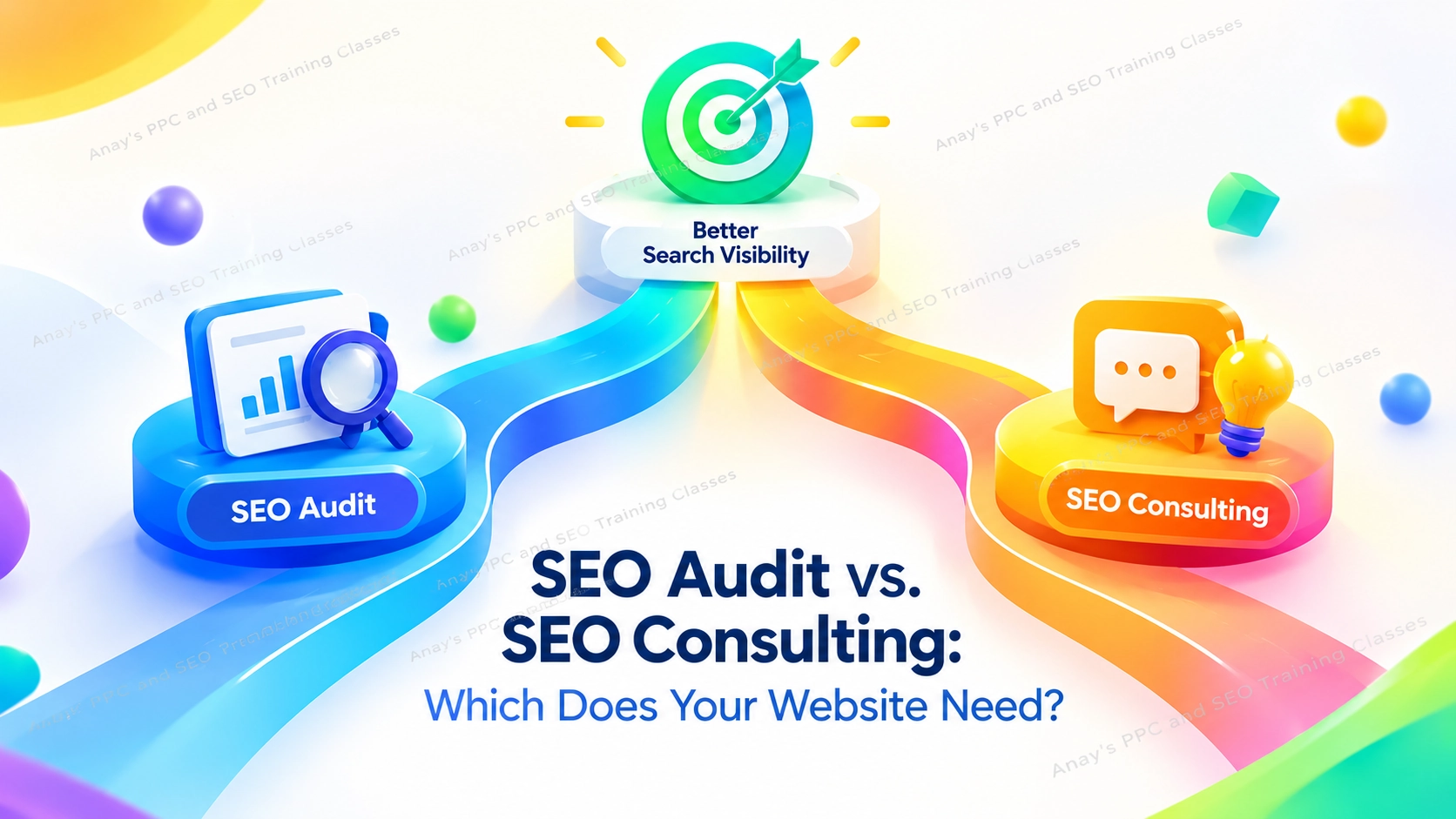
SEO Audit vs. SEO Consulting: Which Does Your Website Need?
An SEO audit and SEO consulting serve different purposes, even though both help businesses make better SEO decisions. An audit identifies website issues and prioritizes recommendations, while consulting helps interpret findings, evaluate options, and decide what to do next. Understanding the difference can help you choose the right support for your website, team, and business goals.
Short answer: An SEO audit is a defined review that identifies problems, prioritizes findings and recommends what to fix first. SEO consulting helps you interpret findings, make decisions and set priorities as circumstances change. Some businesses need only an audit, others need consulting, and some benefit from both.
Most people searching this question have already been burned by something: a tool report with 400 “issues,” two agencies giving contradictory advice, or a recommendation list nobody knew how to act on. The real choice is not audit versus consulting as products. It is which kind of help fits the problem you actually have. I’m writing this to help you pick the right one, including picking neither if neither fits.
An SEO audit is a defined review of a website that identifies SEO issues and prioritizes recommendations. SEO consulting helps a business interpret findings, make informed decisions, and adapt its priorities. A business may need an audit, consulting, both, or neither, depending on its current problems, available evidence, and ability to implement changes.
What an audit is actually for
I use an SEO audit to answer one question: what is the current condition of this website, and what matters most? It is a point-in-time diagnosis with prioritized recommendations, and it has an end point.
The prioritizing is the value. Automated tools will flag hundreds of items, but they can’t tell you which three matter for a business selling services in Ohio versus a national e-commerce store. A good audit turns raw findings into a ranked list tied to your circumstances.
I won’t list what an audit examines here, because I’ve covered that in What Should a Proper Website SEO Audit Actually Check?. If you run a small service business, the article on SEO audits for small service businesses is the closer fit.
One boundary matters: an audit does not include implementation unless that is agreed separately. Finding a problem and fixing it are different jobs.
What consulting is for
SEO consulting is for decisions that keep arising after the diagnosis. Your developer asks whether a set of pages should be indexed. Your writer wants to know which topic to tackle first. Someone proposes a site migration and you need a second opinion before it happens.
Consulting can be ongoing or occasional, depending on what is agreed. It is also not implementation by default. I advise, explain my reasoning and help your team decide; whether I also make changes is a separate scope conversation. If the work you need is hands-on page improvement, that is a different service: my On-Page SEO Services cover content, structure and internal linking, with scope set after review.
Audit and consulting compared
| Comparison | SEO audit | SEO consulting |
|---|---|---|
| Main question | What is wrong, and what matters most? | What should we do next, and why? |
| Typical output | Findings and a prioritized action plan | Advice, decisions and answers to specific questions |
| Shape of the work | Defined, with an agreed end point | Ongoing or as-needed, as agreed |
| Who implements | You, your team, or separately agreed work | You, your team, or separately agreed work |
| Follow-up | Only what the scope includes | Built into the arrangement, as agreed |
| Best fit | You need a clear diagnosis and a starting point | Decisions and priorities keep evolving |
Scope and pricing depend on the website’s size and the questions being answered, so I don’t publish package prices.
Choosing between them
When a one-time audit is enough
If you have developers and writers who can act on a clear list, an audit and a well-prioritized report may be all you need. The team already has the capacity; what it lacks is direction. A defined review gives it that without a standing commitment.
When consulting makes more sense
If you already have an audit, or lots of tool data, but can’t decide what to tackle first, you may need interpretation more than another diagnosis. The same applies if a marketing manager is coordinating developers, writers and existing SEO work and needs a steady outside view.
When starting with an audit and moving to consulting fits
Sometimes you can’t judge how much ongoing guidance you need until you see what the audit finds. In that case, I’d start with the audit and decide on follow-up afterward. Nothing about a good audit should oblige you to buy more.
Field Note from Anay
These illustrative scenarios show how the right choice changes with a business’s resources, existing SEO information and need for ongoing decisions. They are examples, not client case studies.
A business has an in-house developer and content team but doesn’t understand its own SEO problems. The team can do the work, so the missing piece is a prioritized starting point. A defined audit fits.
A business already has an audit but can’t decide which recommendations matter or how to sequence them. A second audit would repeat the first. Consulting, meaning help with interpretation and decisions, fits better.
A marketing manager is juggling developers, writers and existing SEO work and needs recurring guidance. Ongoing consulting can make sense here, but only if the need and scope justify it.
A business has one specific SEO concern and little need for follow-up. A focused review or a single consultation is more proportionate than anything ongoing.
What links these is that the right service follows from who will do the work and what is missing, not from what a provider happens to sell.
Two places where the standard advice breaks down
An audit that nobody owns
A common failure is not a bad report but a good one with no one assigned to act on it. If your team has no capacity or owner for fixes, consulting won’t solve that either. Decide who will implement before you commission anything, or agree implementation as separate work.
A technical audit answering a non-technical question
A technical SEO audit might find few significant technical issues, leading the owner to conclude that SEO isn’t the problem. But if the pages don’t match customer search intent, or the content and site structure need work, a technical review alone won’t establish that. Make sure the questions you need answered are explicitly included in the scope.
Questions to ask before commissioning either
- What exactly will I receive, and in what form?
- Will recommendations be prioritized, or just listed?
- Is implementation included, or separate?
- Who on my side needs to be involved?
- What happens after delivery: is follow-up included, optional, or extra?
- What can’t you promise? (If the answer is “nothing,” be cautious.)
Where to go from here
If you’re still weighing your options, I’d rather you understand your situation than buy the wrong service. You can read about my SEO audits and consulting services, where scope is agreed around your website and the depth of review you need.
If you’d like to talk it through, discuss whether an audit or consulting is right for your website: tell me about the site, your concerns, who handles SEO today and what kind of support you want. I’ll share initial observations on what’s visible, free and with no obligation. That is an overview, not an audit.