What Makes SEO Content Actually Useful — and Worth Optimising?
If your website already has plenty of content but isn’t getting the organic visibility you expected, the usual advice can be frustratingly predictable.
Write more. Publish more often. Target more keywords. Make every article 2,000 words.
But more content doesn’t automatically fix content that isn’t doing its job. Sometimes the problem isn’t that a website needs another ten articles. It is that the content already there needs to be understood, improved, connected or, in some cases, reconsidered.
A better question is:
Does the content on your website actually help the people searching for it — and does it support what your business is trying to achieve?
That is where SEO content strategy becomes much more useful than simply producing pages around keywords.
Content should match search intent, not just a keyword
A page can contain a target keyword in its title, headings and body copy and still miss what the searcher actually wanted.
Someone searching for information about a service may be trying to understand how it works. Someone else may be comparing providers. Another person may already be ready to make contact.
Those are different situations, even if the searches use similar words.
This is why search intent should be considered before content is written or substantially rewritten.
For existing content, the question is fairly simple:
Does this page currently give the searcher what they are likely looking for?
If the answer is no, adding more keywords may not solve the problem. The page may need a different structure, a different focus or, sometimes, a different purpose altogether.
Every page should have a reason to exist
SEO content should have a purpose beyond trying to rank for something.
That purpose might be directly commercial — explaining a service, answering a question before a purchase or helping someone decide whether to make an enquiry.
It might also be indirect. A useful article can demonstrate expertise, answer an important customer question, support another service page or help someone understand a problem before they are ready to buy.
The important thing is that the page has a reason to exist.
If a page was created simply because a keyword research tool produced an interesting phrase, it is worth asking whether that phrase represents a genuine opportunity for the business and its audience.
A good content strategy connects search demand, audience needs and business purpose rather than treating them as three separate exercises.
Think in topics, not isolated keywords
Keywords still have an important role in SEO. They help us understand how people search and give us useful clues about the language they use.
But a useful piece of content should not be built around repeating one phrase as often as possible.
Think about a real person researching a subject. They are likely to have related questions, look for supporting information and move between different parts of the subject.
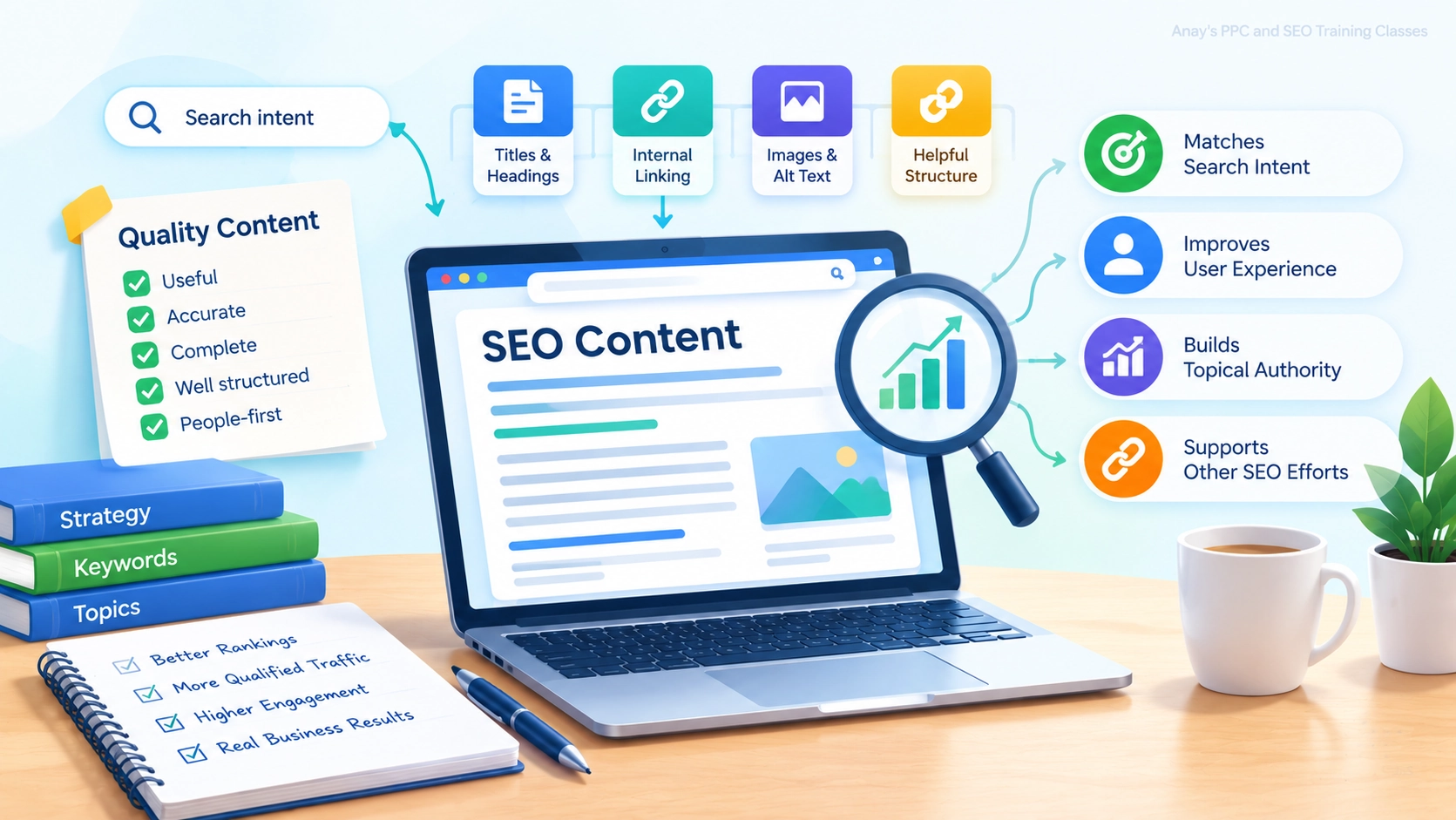
That means good SEO content often needs to consider:
- the main topic
- related concepts and entities
- important subtopics
- questions the audience is likely to have
- supporting information and evidence
- related pages elsewhere on the website
The result should feel like a useful resource, not a page assembled around a keyword.
Keyword stuffing is not a substitute for useful content, and Google explicitly identifies unnatural keyword repetition as a form of spam.
Usefulness comes before optimisation
This is probably the most important point in the whole discussion.
Before asking whether a page is optimised, ask whether it is actually useful.
Useful content should be reasonably accurate, clear, relevant to the audience and complete enough to satisfy the purpose of the page. It should give the reader something they can understand or act on rather than simply filling space.
That does not mean every page needs to be extremely long.
There is no magic word count that turns an ordinary page into good SEO content. Adding paragraphs simply to reach an arbitrary target can make a page harder to read without making it more useful.
The better question is:
What does the reader need to know here, and have we covered it properly?
That is a much more useful starting point for content optimisation.
AI can help — but it doesn’t remove the need for human review
AI-assisted writing has made it much easier to research, structure and produce content.
That can be useful.
But producing content quickly is not the same thing as producing good content.
AI-generated or AI-assisted material still needs human review for accuracy, relevance, originality, tone and whether the information actually makes sense in the context of the business.
There is also a difference between using AI as part of a sensible editorial process and simply generating large numbers of pages because they might attract search traffic. Google’s current spam policies specifically address scaled content created primarily to manipulate search rankings, including large volumes of low-value AI-generated content.
So the useful question isn’t:
“Was AI used to create this?”
It is:
“Does the finished content provide genuine value to the person reading it?”
Improve existing content before automatically creating more
This is one of the areas that is often overlooked.
When a website isn’t performing as expected, the first response is sometimes to create another batch of articles.
But what if the site already has useful pages that are:
- targeting the wrong intent
- too thin to answer the question properly
- outdated
- poorly structured
- competing with another page
- missing important supporting information
- difficult to discover through internal links?
Creating more pages without looking at those problems first can make the overall site harder to manage.
An existing page that already has some visibility, useful information or relevant history may be worth improving before starting a completely new page.
That doesn’t mean every old page should be kept.
Sometimes the right answer is to improve it, consolidate it, redirect it, remove it or leave it alone.
The decision should depend on what the page is doing and what the website actually needs.
A structured SEO audit and consulting review can help identify which content problems deserve attention first, rather than assuming that every underperforming page needs more words or another target keyword.
Find real content gaps
A content gap isn’t simply a keyword that doesn’t appear somewhere on your website.
A meaningful gap is information that your audience needs, that is relevant to the business, and that the site currently does not address adequately.
Finding those gaps can involve looking at:
- questions customers regularly ask
- the search intent behind important queries
- existing pages on the website
- related topics and subtopics
- competing search results
- areas where an existing page is incomplete
- questions that naturally arise before or after a commercial decision
This approach can reveal opportunities that a simple keyword list may miss.
It can also prevent a common problem: creating pages that target technically interesting keywords but have little practical value to the people the business actually wants to reach.
Watch for cannibalisation and overlapping intent
A website can also have too much content on a subject.
For example, several pages may have been created over time around closely related keywords, but they may all be trying to answer essentially the same question.
That creates an awkward situation.
Instead of one clearly focused page addressing a particular search need, the website has several pages with overlapping purposes.
This is commonly described as content cannibalisation.
The solution isn’t necessarily to delete pages. The right response might be to differentiate them, consolidate information, change their purpose or decide which page should be the main resource.
The important thing is to look at the pages together rather than evaluating each one in isolation.
Internal links should help people move through the site
A good content strategy doesn’t stop when an article is published.
Think about what the reader might reasonably want next.
Someone reading an introductory article might need a more detailed guide. Someone researching a problem might eventually want to see a relevant service. Someone comparing solutions might need evidence, examples or a way to contact the business.
Internal links can help create those connections.
They also help search engines understand relationships between pages across a website. Google’s documentation recommends making links crawlable and using relevant link text so that users and search engines can better understand the linked page.
For example, readers who want to explore practical page-level improvements can continue with this guide to improving on-page SEO for a service website.
So internal linking shouldn’t mean adding links simply because an SEO checklist says every page needs them.
The better question is:
Does this link make sense for someone reading this page?
Good SEO content should support the next step
This is where content strategy and commercial SEO come together.
A visitor might arrive through a search query, read an article, explore another related page and eventually decide they need help.
That journey could look something like:
Search → useful answer → related information → relevant service → enquiry
Not every visitor will follow that exact path, and not every article should push someone towards a sale.
But the website should make sensible next steps available.
A genuinely useful article can build trust without turning every paragraph into a sales pitch. A service-focused page can be more direct. The CTA should match the purpose of the page and the position of the reader.
Your CTA should match the content
A call to action is more effective when it makes sense in context.
If someone is reading an introductory educational article, immediately asking them to buy something may feel premature.
On the other hand, someone reading a detailed service page may already be looking for a way to make contact.
That is why a content strategy should consider CTA alignment as well as search intent.
For an article about SEO content, for example, a natural next step may be to discuss an existing website’s content rather than immediately pushing a generic service.
The CTA should feel like a continuation of the reader’s journey, not something that was added because every page was required to have one.
What should you actually optimise?
Once the content has been assessed properly, optimisation becomes much more meaningful.
Depending on the page and the problem identified, that might involve:
- clarifying the search intent
- improving the page structure
- covering missing subtopics
- removing unnecessary material
- improving accuracy or evidence
- making the content easier to understand
- refining titles and headings
- improving internal links
- resolving overlapping pages
- strengthening the connection to relevant commercial pages
- updating outdated information
- improving the page experience where necessary
There isn’t one optimisation formula that applies equally to every page.
A product page, service page, location page and educational article may all need different treatment.
That is why content optimisation works best as part of a broader SEO diagnosis rather than as a standalone exercise in changing keywords.
Useful SEO content isn’t about producing the largest number of pages or hitting a particular word count.
It is about making sure the content on a website has a purpose, matches genuine search intent, covers its subject properly, provides useful information and fits logically with the rest of the site.
Sometimes the answer is a new page.
Sometimes it is an improved page.
Sometimes several pages need to be consolidated.
And sometimes the best decision is not to create anything new at all.
That is why reviewing the content you already have can be just as important as planning what to publish next.
If you’re unsure whether your existing website content is helping or holding back your SEO, a proper review can identify where the opportunities actually are — rather than simply giving you another list of keywords to target. You can explore SEO Audits and Consulting for a broader assessment of your website and its SEO.
If you would like to discuss your website content specifically, contact us or call to discuss what may be worth improving, consolidating or developing.
Frequently asked questions
Does content length affect SEO rankings?
There is no universal word count that guarantees better search performance. Content should be as comprehensive as the subject and the reader’s needs require, without adding unnecessary material simply to make the page longer.
Is keyword density still important for SEO content?
There is no ideal keyword percentage to aim for. Keywords can help communicate the subject of a page, but they should be used naturally and in context. Repeating keywords simply to reach a target density can make content harder to read and may fall into keyword stuffing.
Does AI-generated content rank automatically?
No. The fact that content was produced with AI does not automatically make it useful or successful in search. AI can assist with research, drafting and organisation, but the finished content still needs appropriate human review for accuracy, relevance, originality and usefulness.
What is content cannibalisation?
Content cannibalisation generally refers to situations where multiple pages on the same website have substantially overlapping purposes or search intent. The appropriate response may be to differentiate, consolidate, redirect or otherwise restructure those pages, depending on the circumstances.
Should I create new content or improve what I already have?
It depends on what the existing content is doing. A page that already covers the right subject but needs better structure, information or alignment may be worth improving before creating another page. New content is more useful when there is a genuine, relevant gap that the existing site does not address.
How do I know if my content matches search intent?
Look at what the searcher is likely trying to accomplish and compare that with what your page actually provides. Reviewing the types of pages appearing for the query can also help identify whether the current content is answering the same underlying need.
Do I need to publish content regularly to rank well?
There is no fixed publishing schedule that guarantees better rankings. Publishing regularly can be useful when a business has genuinely valuable subjects to cover, but frequency should not become the objective by itself. The priority should remain useful, relevant and well-considered content.