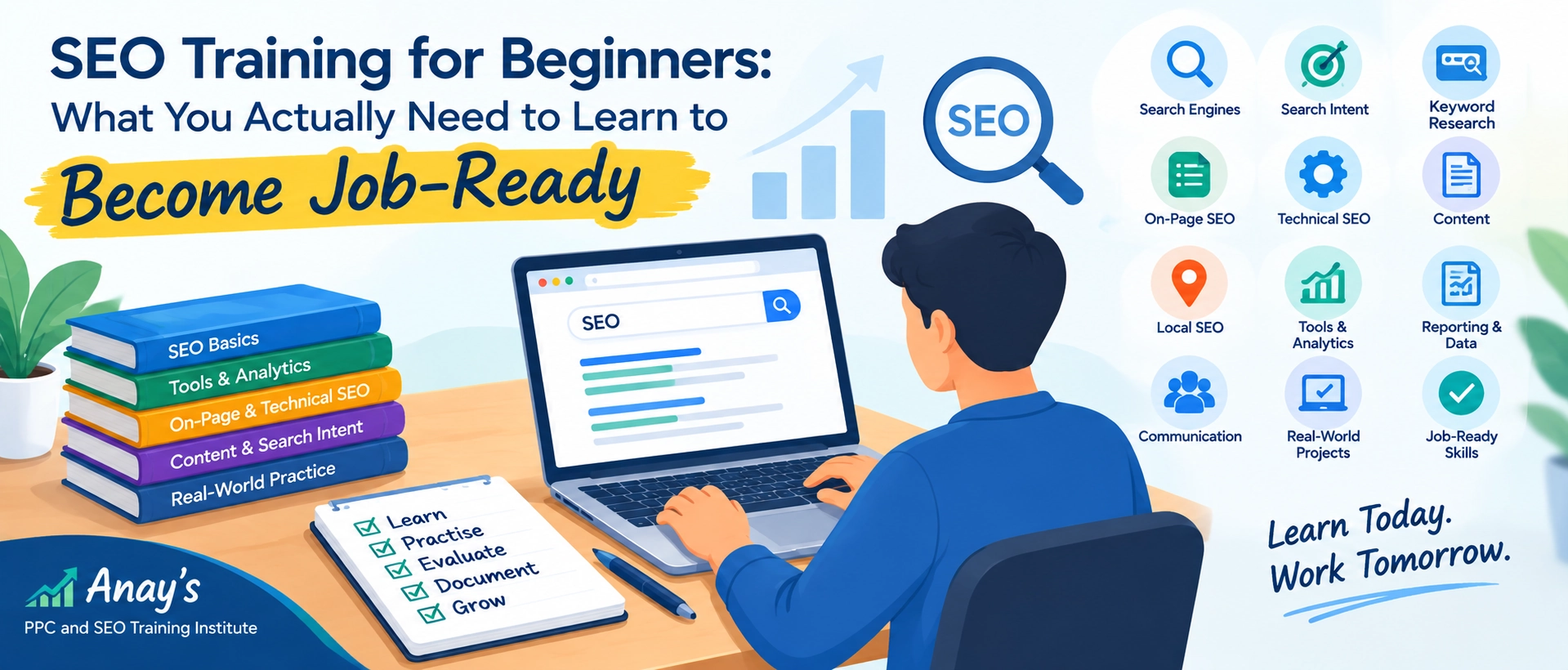
SEO Training for Beginners: What You Actually Need to Learn to Become Job-Ready
Learning SEO and becoming ready to work in SEO are two different things.
A beginner can learn what a title tag is, understand the basic idea of keyword research and recognize terms such as search intent, crawling and indexing.
But knowing SEO terminology is only the beginning.
If you want to become genuinely job-ready, you need to develop the ability to apply what you have learned to real websites, real problems and real business objectives.
You should be able to look at a website, understand what needs attention, explain why it matters, make appropriate recommendations or changes, and communicate your work clearly.
That is what good beginner SEO training should help you develop.
If you are looking for structured guidance while developing these practical skills, you can learn more about our Live Online SEO Training.
This guide explains the knowledge, practical abilities and working habits a beginner should develop to become ready for entry-level SEO work.
What Does “Job-Ready” Mean in SEO?
Being job-ready does not mean knowing every part of SEO.
SEO is a broad field, and even experienced professionals continue to learn as search engines, websites, tools and best practices change.
For a beginner, job readiness means having enough understanding and practical ability to handle common SEO tasks responsibly.
You should be able to:
- understand what a business is trying to achieve;
- evaluate a website at a basic level;
- identify common SEO issues;
- carry out fundamental SEO tasks;
- use commonly required SEO tools;
- explain your findings;
- document your work;
- follow instructions from a brief;
- communicate questions and progress;
- and understand when something requires more investigation or specialist knowledge.
The exact responsibilities will vary from one SEO role to another.
The important point is that employers generally need someone who can do useful work, not someone who has merely memorized SEO definitions.
1. Understand How Search Engines Work
A beginner should understand the basic concepts behind:
These include:
- crawling;
- indexing;
- ranking;
- search results;
- organic search;
- search queries;
- search intent.
You do not need to become a search-engine engineer.
You do need enough understanding to explain why a page might be discovered, indexed, ranked or excluded.
This foundation makes later SEO concepts much easier to understand.
2. Understand Search Intent
You should be able to consider what a person is trying to accomplish when they search.
A search may indicate that someone wants to:
For example, someone may want to:
- learn something;
- compare alternatives;
- find a particular website or business;
- buy a product;
- contact a service provider;
- solve a problem.
Job-ready SEO work requires more than identifying a keyword. You should be able to consider whether the content or page being optimized actually meets the likely need behind the search.
3. Understand Keyword Research
Keyword research remains an important SEO skill, but job readiness involves more than producing a list of phrases.
You should understand how to evaluate:
This includes:
- relevance;
- search intent;
- business value;
- competition;
- search demand;
- variations and related searches;
- the suitability of an existing page;
- and whether a new page may be needed.
You should also understand the difference between a keyword and the actual search query entered by a user.
The goal is to use keyword information to make sensible decisions about content and website structure.
4. Evaluate On-Page SEO
A beginner should be able to examine the major on-page elements of a page.
These can include:
- page title;
- meta description;
- headings;
- content;
- internal links;
- URLs;
- image optimization;
- keyword relevance;
- search intent;
- content structure.
You do not need to memorize a rigid formula for every page.
You need to learn how to evaluate whether a page is relevant, useful, understandable and appropriately optimized for its intended topic.
For a deeper explanation of on-page SEO, see our dedicated article on On-Page SEO.
5. Understand Technical SEO Fundamentals
You do not need to become a technical SEO specialist to begin working in SEO.
You should, however, understand fundamental concepts such as:
These include:
- crawling;
- indexing;
- robots.txt;
- XML sitemaps;
- canonical URLs;
- redirects;
- broken links;
- duplicate or near-duplicate pages;
- mobile usability;
- HTTPS;
- page experience and performance considerations.
Most importantly, you should learn to recognize when a technical issue may affect search visibility and when it needs investigation by someone with deeper technical expertise.
6. Understand Content as an SEO Asset
SEO and content are closely connected.
A beginner should understand how content can support:
Content can support:
- search intent;
- topical relevance;
- customer questions;
- organic visibility;
- internal linking;
- the user’s journey through a website.
You should also learn to distinguish between content created merely to target keywords and content that genuinely helps the intended audience.
Good SEO content starts with understanding the user and the purpose of the page.
7. Understand Local SEO Fundamentals
If you work with local businesses, you should understand the basic principles of local SEO.
This includes concepts such as:
These can include:
- local search intent;
- business information consistency;
- location-specific pages;
- reviews;
- local relevance;
- Google Business Profile;
- local search visibility.
The exact tasks will vary according to the business and the role.
A beginner should at least understand how local search differs from a purely national or global SEO strategy.
8. Learn to Use Google Search Console
Google Search Console is an important tool for SEO work.
A beginner should learn how to use it to investigate areas such as:
These may include:
- search performance;
- queries;
- pages;
- indexing;
- sitemap information;
- technical issues;
- search appearance;
- and other available reports relevant to the website.
The important skill is not simply knowing where each report is located.
You should learn how to interpret the information and turn it into a useful SEO observation.
For example:
What does the data show?
Why might it matter?
What should be investigated next?
That is the beginning of analytical SEO work.
9. Become Comfortable With Common SEO Tools
You do not need to master every SEO tool before applying for your first role.
You should, however, become comfortable working with the tools that are relevant to the type of SEO work you want to perform.
Depending on the role, these may include:
Depending on the role, these may include:
- Google Search Console;
- Google Analytics;
- keyword research tools;
- crawling tools;
- SEO auditing tools;
- spreadsheet software;
- reporting platforms.
More important than the number of tools on your CV is your ability to use the available information sensibly.
10. Perform a Basic SEO Audit
A beginner should learn how to conduct a structured basic SEO review.
This might involve checking:
A basic review might involve checking:
- indexing;
- titles and meta descriptions;
- headings;
- URLs;
- internal links;
- content relevance;
- technical issues;
- sitemap and robots.txt information;
- broken links;
- mobile considerations;
- local SEO elements where applicable.
A basic audit is not about finding as many issues as possible.
It is about identifying meaningful issues, understanding their potential importance and presenting the findings clearly.
For a deeper look at the audit process, see our article on SEO Audits.
11. Learn to Work From an SEO Brief
This is one of the skills that separates learning SEO from working in SEO.
In a real job, you may not be told:
Review the service pages and identify opportunities to improve their organic visibility.
You then need to determine:
You may need to determine:
- what information you need;
- which pages need review;
- which tools to use;
- what to investigate;
- what evidence to collect;
- what recommendations are appropriate;
- and how to present your findings.
Learning to work from a brief helps you move from classroom exercises toward professional work.
12. Learn to Document Your Work
SEO work often involves research, recommendations, changes and follow-up.
You should learn to document:
Your documentation should capture:
- what you reviewed;
- what you found;
- what you changed;
- why you recommended the change;
- what evidence supported the recommendation;
- what remains outstanding;
- and what should happen next.
Clear documentation is valuable when working with managers, clients, developers, writers and other members of a marketing team.
It also makes your own work easier to review later.
13. Learn Basic SEO Reporting
An SEO professional needs to communicate what is happening.
A beginner should understand how to report relevant information such as:
Relevant information may include:
- organic traffic;
- impressions;
- clicks;
- rankings or visibility indicators;
- conversions;
- indexed pages;
- important SEO issues;
- completed work;
- outstanding recommendations.
The exact metrics will depend on the project.
A useful report should help the reader understand what happened, what it means and what should happen next.
A report full of numbers is not automatically a useful SEO report.
14. Learn to Interpret Data
Data interpretation is more valuable than simply collecting data.
For example, if organic clicks increase, you should be able to ask:
You should ask:
- Which pages contributed to the increase?
- Which queries changed?
- Did impressions also change?
- Did the change produce meaningful business outcomes?
- Could another factor explain the movement?
Similarly, a decline in traffic does not automatically mean that an SEO campaign failed.
You need to investigate before drawing conclusions.
This habit of looking for evidence before making recommendations is an important part of becoming job-ready.
15. Understand Real-Website Constraints
SEO is rarely performed on a perfect website.
Real websites may have:
Common constraints include:
- outdated content;
- technical limitations;
- CMS restrictions;
- development backlogs;
- limited budgets;
- incomplete tracking;
- inconsistent business information;
- approval processes;
- competing business priorities.
A beginner should learn to work within those constraints rather than assuming that every recommended change can be implemented immediately.
Good SEO recommendations consider both what would be ideal and what is realistically achievable.
16. Learn Basic SEO Communication
SEO professionals frequently need to communicate with people who are not SEO specialists.
You may need to explain an issue to:
You may work with:
- a business owner;
- a marketing manager;
- a content writer;
- a developer;
- a designer;
- a client;
- or another member of the SEO team.
Being able to explain an SEO issue in plain language is therefore an important professional skill.
Instead of saying only:
This page has a canonicalization problem.
you should be able to explain what the issue means, why it may matter and what action you recommend.
17. Understand Collaboration and Handoffs
SEO often involves work that crosses departmental boundaries.
For example:
SEO → content → development → implementation → SEO validation
A beginner should learn to provide information that another person can actually use.
That might mean giving a developer a clear technical recommendation, giving a writer a well-defined content brief or documenting what needs to be checked after an implementation.
Understanding where your responsibility ends is also part of professional SEO work.
18. Learn to Work to Deadlines
SEO work is often organized around deadlines.
You may have to:
For example, you may need to:
- complete an audit by a certain date;
- prepare keyword research for a content calendar;
- review pages before publication;
- deliver a report;
- follow up on implementation;
- or complete several tasks within a working week.
A job-ready beginner should learn to break a task into manageable steps, estimate what can realistically be completed and communicate early if something is blocked.
Professional reliability matters alongside technical knowledge.
19. Build Evidence of Your Practical Skills
A beginner does not necessarily need years of professional experience to demonstrate useful SEO ability.
You can build evidence through appropriate practical projects.
For example, you might create:
Examples include:
- a sample SEO audit;
- a keyword research document;
- an on-page optimization exercise;
- a content brief;
- a technical SEO checklist;
- a sample SEO report;
- a website improvement case study based on a practice project.
The important thing is to be completely honest about the source and results.
If a project is a practice exercise, describe it as a practice exercise.
Do not invent traffic increases, ranking improvements, client results or employment experience that did not actually happen.
A smaller portfolio with honest, well-explained work is much more useful than impressive-looking claims that cannot be supported.
20. Develop Professional SEO Judgment
This may be the hardest skill to teach and the most important one to develop.
SEO decisions rarely come from a single rule.
You may need to consider:
You may need to consider:
- the searcher’s intent;
- the business objective;
- the existing website;
- technical limitations;
- available data;
- implementation effort;
- potential impact;
- and competing priorities.
Good SEO judgment means being able to explain why you recommend something rather than simply repeating an SEO rule.
Knowledge Is Not the Same as Ability
Consider two beginners.
Candidate A can explain what a title tag is.
Candidate B can look at a real page, recognize that its title does not accurately represent the page or align well with the likely search intent, explain the problem and propose a sensible replacement.
Both candidates know what a title tag is.
Candidate B has demonstrated a more useful workplace skill.
This distinction applies throughout SEO.
Knowing a definition is knowledge.
Being able to evaluate a situation, make an appropriate decision and explain your reasoning is practical ability.
That is the difference good SEO training should help you develop.
What About Link Building?
Link building is part of SEO, but it should not be treated as the entire discipline.
A beginner should understand the basic concepts around links, authority and link relevance.
The amount of hands-on link-building work required will depend on the role.
Some SEO positions may place significant emphasis on outreach and off-page work. Others may focus more heavily on technical SEO, content, on-page optimization, local SEO, analytics or project coordination.
When evaluating a training program or job description, look at the actual responsibilities rather than assuming that every SEO role requires the same skill set.
How Should You Progress From Learning to Job Readiness?
A sensible progression might look like this:
Learn → Practice → Evaluate → Document → Explain → Improve
First, learn the underlying concept.
Then practice applying it.
After that, evaluate your own work and look for weaknesses.
Document what you did and why.
Practice explaining your decisions clearly.
Then use feedback to improve.
This cycle is more useful than simply completing lesson after lesson without applying what you have learned.
If you are building these skills and want structured, practical guidance rather than training that stops at terminology, our Live Online SEO Training is designed around practical learning and application.
What Should You Look for in SEO Training?
When comparing SEO courses or training programs, look beyond the number of modules, hours or certificates.
Ask what you will actually be able to do after completing the training.
A useful beginner program should include:
Look for training that includes:
- SEO fundamentals;
- practical exercises;
- real or realistic website examples;
- keyword research;
- on-page SEO;
- technical SEO fundamentals;
- content and search intent;
- SEO tools;
- audits;
- reporting;
- data interpretation;
- practical problem-solving;
- and opportunities to receive feedback.
If the goal is employment, training should also help you understand how SEO work is actually assigned, documented and communicated.
A certificate can show that you completed a program.
It does not by itself demonstrate that you can perform SEO work.
Be cautious of training that presents guaranteed rankings or guaranteed SEO results as a normal outcome; legitimate SEO work cannot promise a fixed ranking position.
SEO Job-Readiness Checklist
Before considering yourself ready to apply for entry-level SEO work, ask whether you can confidently say yes to questions such as:
Ask yourself:
- Can I explain how search engines discover and index pages?
- Can I identify the likely search intent behind a query?
- Can I conduct basic keyword research?
- Can I evaluate a page’s on-page SEO?
- Can I identify common technical SEO issues?
- Can I use Google Search Console at a basic working level?
- Can I perform a structured basic SEO audit?
- Can I interpret basic SEO data?
- Can I create a useful SEO report?
- Can I work from an SEO brief?
- Can I document my findings and recommendations?
- Can I explain an SEO issue to a non-SEO person?
- Can I create examples of my work without exaggerating the results?
- Can I work through a task and meet a reasonable deadline?
- Can I explain the reasoning behind my recommendations?
You do not need to answer yes to every advanced SEO question.
The checklist is intended to help you identify the areas where more practice is needed.
Frequently Asked Questions
How do I know if I am job-ready for an SEO role?
You are moving toward job readiness when you can apply fundamental SEO knowledge to practical tasks without needing every step explained to you. You should be able to investigate a website, identify common issues, use basic SEO tools, make reasoned recommendations, document your work and explain your decisions clearly.
How long does it take to become job-ready in SEO?
There is no universal timeframe. It depends on your starting knowledge, how consistently you study, how much practical work you complete and the type of SEO role you are targeting. Learning the fundamentals can happen relatively quickly, but developing reliable judgment requires repeated practice.
What should I include in an SEO portfolio as a beginner?
Include practical work that demonstrates how you think and work. Suitable examples can include a sample SEO audit, keyword research, an on-page optimization exercise, a content brief or a sample SEO report. Clearly label practice projects as practice projects, and never invent results or experience.
Building the Skills to Become Job-Ready in SEO
Becoming job-ready in SEO is a progression from understanding concepts to applying them with increasing independence.
A strong beginner should be able to take a task, understand what is required, investigate the relevant information, make sensible recommendations, document the work and communicate the reasoning behind it.
You do not need to know everything before beginning your SEO career.
You do need a reliable foundation, practical experience, honesty about what you know, and the willingness to keep learning as you encounter new websites and new problems.
That is the standard worth looking for when choosing SEO training—and the standard worth working toward if your goal is to become capable of handling real SEO work.
If you would like to discuss practical SEO training for your learning goals, Contact Us, Call or Email.