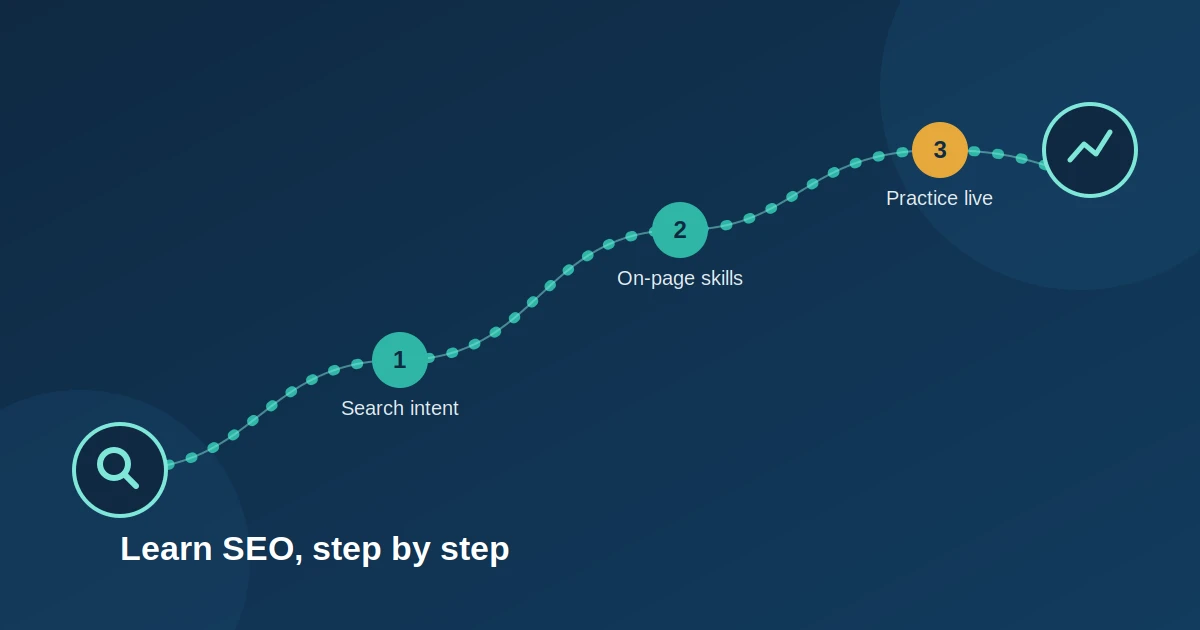
How to Learn SEO Online: A Practical Beginner Roadmap
Search “how to learn SEO online” and you’ll get a hundred conflicting lists of tools, courses and “10 SEO hacks” articles. Most of it skips the actual order things need to happen in. This is a practical roadmap — what to learn first, what to learn once the basics are solid, and what to leave until later.
Yes, a beginner can learn SEO online
SEO doesn’t require a technical or marketing degree. It requires understanding how a search engine like Google actually works, then practicing a fairly small set of skills repeatedly on real pages. What separates people who get good at it isn’t raw intelligence — it’s whether they practice on an actual website rather than only reading about it.
Step 1: Understand how Google finds and ranks pages
Before touching any tool, it’s worth understanding the three-stage process Google itself describes: crawling (finding pages), indexing (storing and organizing them), and serving (deciding what to show for a given search). Google’s own SEO Starter Guide and Search Essentials documentation are free, current, and written by the people who run the search engine — a stronger starting point than most paid courses, and worth reading before anything else.
Step 2: Learn search intent and keyword research
Every search has an intent behind it — informational, navigational, commercial, or transactional. Learning to read that intent, then finding the actual words and phrases people use to search for a topic, is the foundation everything else sits on. This is a skill you build by researching real topics, not by memorizing definitions — we go into this in more depth in on-page SEO.
Step 3: Learn on-page optimisation
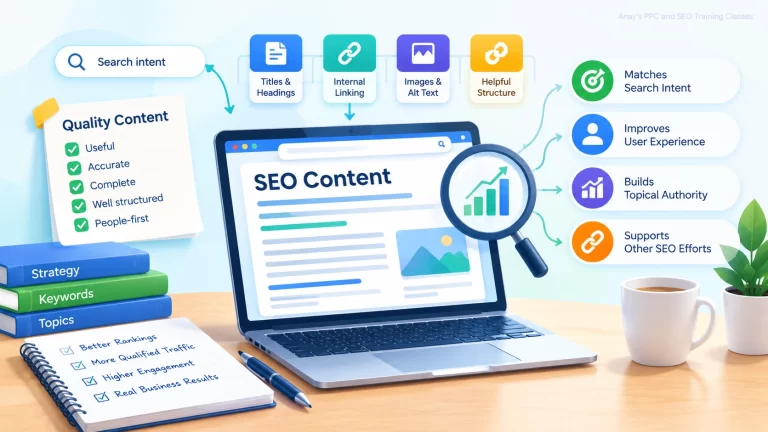
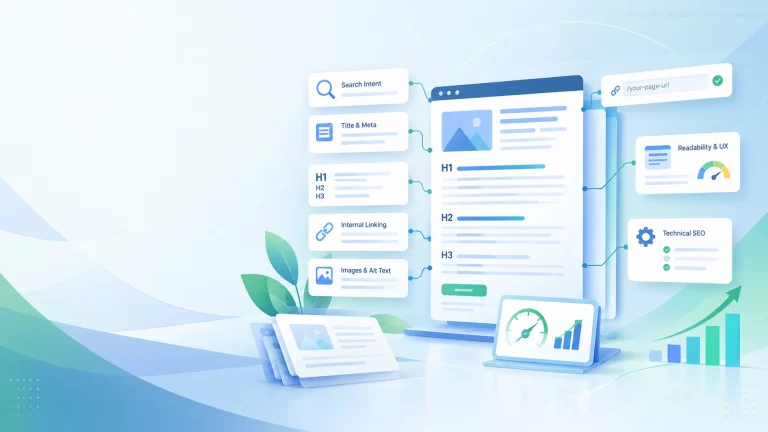
Title tags, meta descriptions, heading structure, internal linking, and writing content that actually answers the intent behind a query. This is the most learnable part of SEO because the feedback loop is short — you can apply a change to a real page and see the difference in how the page reads and performs.
Step 4: Get comfortable in Google Search Console
Search Console is Google’s free tool for seeing how your own site is actually being crawled and how it performs in search. Learning to read its Coverage/Indexing report, Performance report, and Core Web Vitals data turns SEO from guesswork into something you can measure. There’s no substitute for spending time in a real account, even a small personal site, rather than only looking at screenshots in a course.
Step 5: Practice on a real site
This is the step most beginners skip, and it’s the one that actually builds the skill. A free blog, a portfolio site, or a friend’s small business site all work. Apply what you’ve learned, check Search Console a few weeks later, and see what happened. SEO has a real feedback delay — search engines take time to recrawl and re-evaluate pages — so this step also teaches patience, which is arguably as valuable as any technical skill. If structured feedback sounds more appealing than guessing alone at this stage, it helps to know that guided options exist for exactly this kind of practice.
What to leave until later
Off-page activity (building your site’s presence and references elsewhere on the web) is a real part of SEO, but it’s also where beginners most often pick up bad habits from low-quality advice. It’s worth understanding conceptually early on, but not worth practicing hands-on until the on-page and technical fundamentals above are solid.
How long does it realistically take?
There’s no fixed number — it depends on how much time you put in and whether you’re practicing on a real site or just reading. A reasonable expectation is: basic working competence (you can audit and improve a simple page correctly) within a few months of consistent practice, with genuine skill continuing to build well beyond that through repeated hands-on work. Anyone promising mastery in a fixed number of weeks is selling something.
Do you need coding knowledge?
No. Understanding basic HTML structure helps, and picking up simple technical concepts over time makes you more effective, but SEO itself is not a coding discipline. Most of the day-to-day work is research, writing, and structure — not programming.
When structured guidance helps
Self-teaching works, but it’s slow going without feedback — it’s easy to practice the wrong thing confidently for months without realizing it. If you’re finding the self-taught route frustrating, or you want feedback on real work rather than generic theory, structured guidance can shorten that gap considerably. If you’d like a guided version of this roadmap, our Live Online SEO Training works through these exact fundamentals with practical, hands-on sessions rather than just theory.
If you would like to discuss whether guided SEO training is right for you, call +91 94648 71085 or contact me.
Frequently Asked Questions
Can a beginner learn SEO online?
Yes. The core skills — search intent, keyword research, on-page optimization, and reading Search Console data — are all learnable without a technical background, through free official resources plus hands-on practice.
How long does it take to learn SEO basics?
There’s no universal timeline; it depends on time invested and whether you’re practicing on a real site. A few months of consistent, hands-on practice is a reasonable expectation for basic working competence, with skill continuing to build after that.
Do I need coding knowledge to learn SEO?
No. A basic understanding of HTML structure helps, but SEO is primarily research, writing, and structural work rather than a programming discipline.