
What Should a Proper Local SEO Strategy Actually Include?
Ask five different people what local SEO involves and you’ll probably get five different answers. For some, it’s synonymous with “set up your Google Business Profile.” For others, it’s a pile of local listings and a handful of reviews. Both are part of the picture, but neither comes close to describing what a proper local SEO strategy actually needs to cover.
If your customers find you by searching for something “near me” or within a specific area — a city, a region, or a defined service area — local SEO is worth getting right. Not because it’s a magic switch that puts you at the top of the map results, but because it helps search engines and the people using them understand what you do, who you serve, and where.
Here’s what that actually involves.
What Local SEO Actually Covers
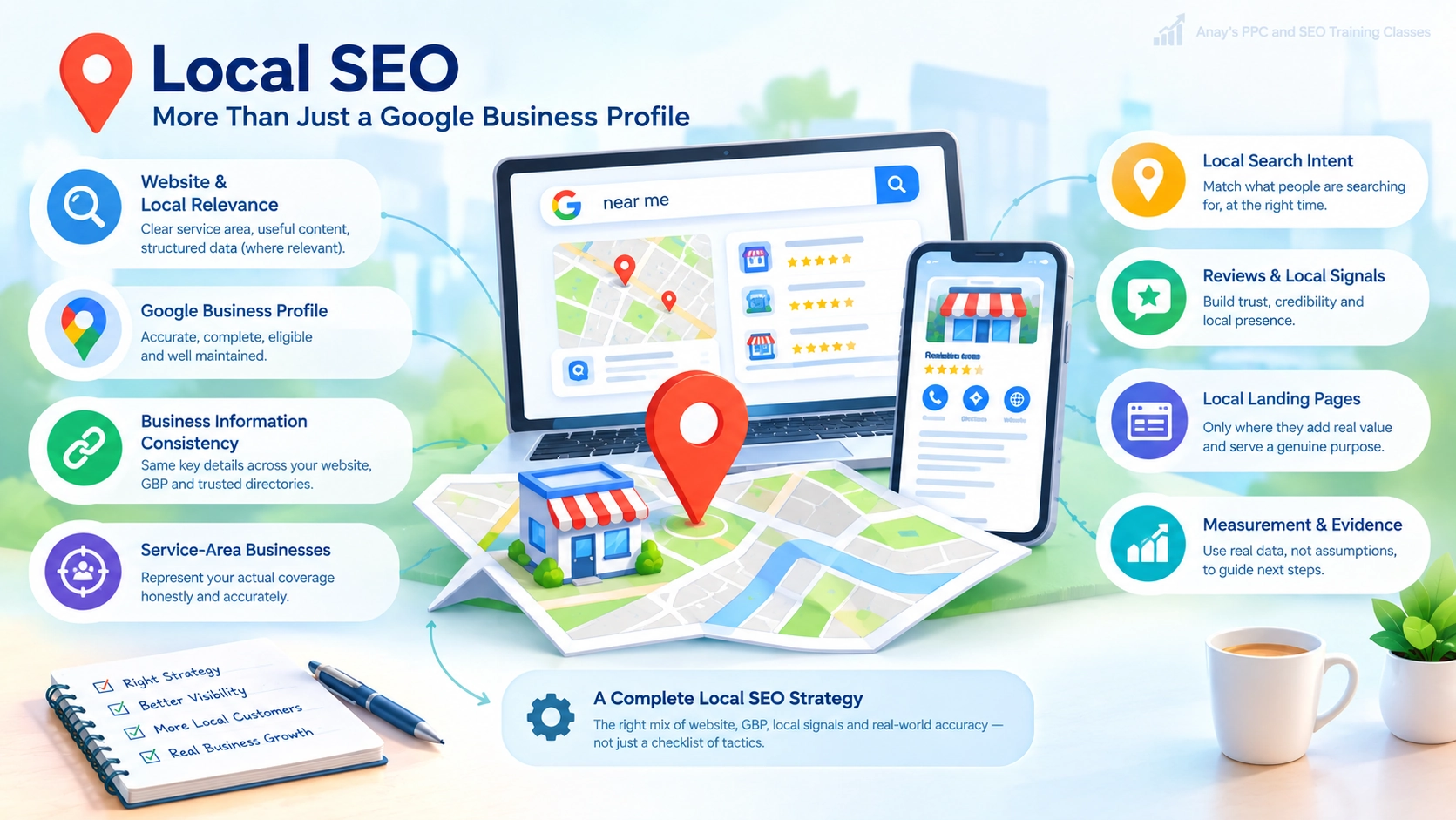
Local SEO sits at the intersection of your website, your Google Business Profile, and the broader information that helps search engines understand your business and the areas it genuinely serves.
It’s not a completely separate discipline from ordinary SEO. It is SEO with an additional layer of geographic relevance: making sure your location, service area and business information are represented accurately wherever they matter.
That means it can touch your website’s content and structure, your Business Profile, relevant business listings, reviews, local search intent, and the consistency of your business information across the web.
A proper strategy looks at how these pieces fit together rather than treating each one as an isolated task.
Website and Local Relevance
Your website needs to make it reasonably clear — to both visitors and search engines — what you do and where you do it.
That doesn’t mean stuffing city names into every paragraph. It means your service pages, about information, contact details and other relevant content should accurately reflect your actual service area without exaggerating it or leaving it unnecessarily vague.
For example, a business genuinely serving several nearby towns may benefit from making that service coverage clear on the relevant pages. A business that only serves one location shouldn’t create dozens of pages simply because those locations have search volume.
Local relevance should describe the business that actually exists, not a version of it created purely for search engines.
Google Business Profile Considerations
Your Google Business Profile is one of the most visible parts of local SEO, but it isn’t the whole strategy.
A proper approach considers whether the business is eligible for a Business Profile and for the particular features being used, whether the business information is accurate, and whether the profile represents the real business appropriately. If you need guidance on Google Business Profile setup, the process should begin with the business’s actual eligibility and details.
Depending on the business, that can include information such as the business category, hours, website, phone number, location or service area, photos and other relevant profile information.
It’s also worth saying plainly: Google controls Business Profile eligibility, verification, restrictions, reinstatement and how profiles appear in its search and Maps results. An SEO provider can review a profile, identify potential issues and suggest reasonable actions, but cannot legitimately guarantee a particular outcome.
What Influences Local Search Visibility?
Google says local results are mainly based on relevance, distance and prominence. These are useful concepts to understand, but they aren’t a formula that an SEO provider can manipulate to guarantee a particular position.
Relevance is about how well a business matches what someone is searching for. Clear, complete and accurate business information can help Google understand what the business offers.
Distance refers to how far the business is from the person searching, or from the location included in the search. This is one reason why local search results can differ depending on where the search is made.
Prominence relates to how well-known a business is. Google considers information it has about the business across the web, including factors such as links and reviews.
These factors overlap with other parts of SEO and online business visibility, but they don’t give businesses a guaranteed way to control where they appear. A proper local SEO strategy works with the available evidence rather than promising a particular map position.
Business Information Consistency
Accurate business information matters across your website, Google Business Profile and relevant third-party listings.
That includes details such as the business name, address where applicable, phone number, website and other information used to identify or describe the business.
An old address, outdated phone number or inconsistent business description can create an inaccurate picture of the business. Google also gathers information about local businesses from multiple sources, so keeping important information accurate wherever it is published is a sensible part of maintaining a reliable online presence.
The objective isn’t to make every website on the internet look mechanically identical. It’s to make sure the business is represented accurately and consistently where that information matters.
Service-Area Businesses
Not every local business operates from a single, publicly visitable location.
A service-area business — one that travels to customers rather than serving them from a traditional storefront — has different considerations around how it represents its coverage area and how it presents its Business Profile.
This is an important distinction because a business shouldn’t simply add every nearby town or city to its marketing because those locations have potential search demand.
The service area should reflect where the business genuinely operates. Accurate representation is more important than creating the appearance of a larger geographic footprint.
Local Search Intent
Someone searching “plumber near me” is in a very different position from someone searching “how do plumbing systems work.”
Local search intent is often more immediate and decision-oriented. The searcher may want to find, compare, call, visit or enquire about a business.
Content designed for local intent should reflect that. It should be clear, direct and useful to someone making a local decision rather than simply being a general article with a city name inserted into it.
Understanding that intent also helps determine which pages should be optimised for local searches. Not every page on a website needs to become a local landing page.
Eligibility and Representation Matter
Not every business qualifies for every local SEO tactic, and a proper strategy accounts for that before tactics are applied.
Questions worth considering include:
- Is the business eligible for a Google Business Profile?
- Does it have a physical location, operate as a service-area business, or have another legitimate business model?
- Is the stated service area accurate?
- Does the website accurately describe what the business does and where it operates?
- Are the local pages and business listings representing something that actually exists?
These questions may sound basic, but they can prevent a business from building an SEO strategy around assumptions that don’t match reality.
If a Business Profile has been suspended or is affected by a policy issue, the next step should be based on the circumstances rather than a promise of reinstatement. A review of the available information can help identify possible issues and appropriate next steps.
Local Landing Pages — Where They’re Genuinely Useful
Local landing pages — dedicated pages for specific cities or service areas — can be a legitimate part of a local SEO strategy.
But each page should have a genuine reason to exist.
A page created simply to target another city name, with almost identical content to every other location page on the site, doesn’t provide much additional value to a searcher. Creating dozens of near-duplicate location pages simply because those places have search demand isn’t a substitute for genuinely serving those areas.
If a business genuinely serves multiple distinct areas and there is useful, relevant information to provide about each one, separate pages may make sense.
The question shouldn’t be “How many city pages can we create?”
It should be “Does each page genuinely help someone looking for this service in this particular area?”
Reviews Are One Part of the Picture, Not the Whole Strategy
Reviews matter for local businesses because they can influence how potential customers perceive a business, and Google also identifies reviews as one factor associated with local prominence.
But reviews are one part of local SEO, not a stand-alone strategy.
A business can have a strong review profile while still having inaccurate business information, weak local relevance on its website or an incomplete Business Profile.
Reviews should be earned honestly and managed as part of the wider customer and local-search presence. They shouldn’t be manufactured, manipulated or treated as something an SEO provider can guarantee recovering if a profile has lost reviews or encountered a policy issue.
Structured Data Can Help Search Engines Understand the Business
Where appropriate, structured data can provide search engines with additional information about the content and the business represented on a webpage.
For eligible local-business websites, LocalBusiness structured data can describe information such as the business name, address, telephone number, opening hours and other relevant details.
But structured data is not a shortcut to better rankings or a guarantee that a particular search feature will appear.
It should support information that is already accurately represented on the page, not be used to create claims that aren’t visible or true.
What Should a Local SEO Review Actually Examine?
A useful local SEO review should go beyond checking whether a business has a Google Business Profile. For a broader look at the website’s technical health and optimisation, a focused SEO audit can help put potential issues into context.
Depending on the business, it may examine:
- Business Profile eligibility and accuracy — whether the profile represents the actual business and uses appropriate information.
- Business information — whether important business details are accurate and consistent across relevant sources.
- Website local relevance — whether the site clearly explains what the business does and where it genuinely operates.
- Local search intent — whether important pages match what people are actually trying to find when they search locally.
- Location and service-area pages — whether existing pages are useful and whether additional pages are genuinely justified.
- Reviews and other local signals — as part of the wider picture rather than as the entire strategy.
- Performance evidence — including available Business Profile performance data and relevant website/search data.
- Technical and on-page issues — because local relevance cannot compensate for a page that search engines cannot properly access, understand or index.
The exact review should depend on the business, its market, its current website and the evidence available. There isn’t one checklist that makes sense for every local business.
If you are unsure which areas deserve attention first, an evidence-based review can help distinguish meaningful issues from tasks that may not be relevant to your business.
Measurement and Evidence
Like any SEO work, local SEO should be evaluated against real evidence rather than assumptions.
For a verified Business Profile, available performance data can show how people discover and interact with the profile, including searches, views and certain customer actions. Website and search-performance data can add another layer of context, particularly for pages targeting local intent.
The important point is not to collect numbers simply because they are available.
The useful question is what the evidence says about the current situation and what should be prioritised next.
A business shouldn’t be told to carry out ten local SEO tasks simply because they appear on a generic checklist if the available evidence doesn’t show that those tasks are relevant.
How Local SEO Differs From National or International SEO
The core principles overlap — search intent, content relevance, technical soundness and useful information — but local SEO adds another requirement: accurately representing a genuine location or service area.
A national or international website may primarily compete for broader search visibility across a market.
A local business also needs its geographic relevance to make sense.
That means location, service area, business information, local search intent and Business Profile considerations can become important parts of the SEO picture.
The distinction isn’t simply about adding a city name to a page. It’s about whether the business, website and local presence genuinely correspond to the searches being targeted.
Building a Local SEO Strategy Around Real Business Needs
None of this works particularly well in isolation.
A carefully maintained Google Business Profile attached to a website that says almost nothing useful about the business or its service area leaves part of the picture unresolved.
A locally relevant website undermined by inaccurate business information creates a different problem.
And a collection of city pages, reviews or directory listings cannot compensate for a strategy that doesn’t accurately represent what the business actually does.
A proper local SEO strategy treats these as connected parts of the same picture — diagnosed, prioritised and reviewed according to the business rather than tackled as a fixed list of disconnected tasks.
If you’re trying to work out which of these pieces are actually in place for your business — and which ones may need attention — that’s the kind of review our Local SEO services are designed to address.
You’re welcome to request a local SEO review if you’d like an outside, evidence-based look at where things currently stand. You can Contact Us to discuss your requirements or Call if you’d prefer to speak directly.
Frequently Asked Questions
What is local SEO?
Local SEO is the practice of helping a business be accurately and clearly represented to search engines and searchers within a specific geographic area or service area. It can involve the business website, Google Business Profile, relevant business listings, local search intent and other information that helps establish the business’s local relevance.
Is local SEO just about Google Business Profile?
No. Google Business Profile is an important and highly visible part of local SEO, but a proper strategy can also cover website relevance, business information, local search intent, service-area representation, relevant listings, reviews and performance evidence.
Can you guarantee my business will show up in Google’s local map results?
No responsible local SEO strategy can guarantee a specific ranking or map placement. Local results are influenced by factors including relevance, distance and prominence, and Google controls how its search and Maps systems determine and display results.
Do I need a separate page for every city I serve?
Not necessarily. A separate location page should have a genuine reason to exist and provide useful, relevant information about that area. Creating substantially duplicated pages simply by replacing one city name with another is not a sound substitute for genuinely serving those locations.
How important are reviews for local SEO?
Reviews are a meaningful part of a local business’s online presence and can contribute to how customers perceive the business. Google also identifies reviews as one factor associated with local prominence. But reviews are only one component of a broader local SEO strategy.
What’s the difference between local SEO and regular SEO?
Regular SEO focuses on helping pages match search intent and be understood and discovered in search. Local SEO adds the requirement of accurately representing a genuine location or service area, along with the local information and signals that help connect a business with relevant local searches.
Can local SEO help a service-area business that doesn’t have a storefront?
Yes. Service-area businesses have their own considerations for how they represent their coverage, Business Profile and website. The important point is that the areas presented should reflect where the business genuinely operates rather than being selected solely for search demand.
What happens if my Google Business Profile has already been suspended or has an issue?
Google controls verification, restrictions and reinstatement decisions, so no provider can guarantee a particular outcome. A proper review can, however, examine the available information, identify potential issues and help determine what reasonable next steps may be appropriate.